EAST AFRICA 2025 – EPISODE SEVEN

APRIL 2nd. THE END OF ANOTHER SAFARI

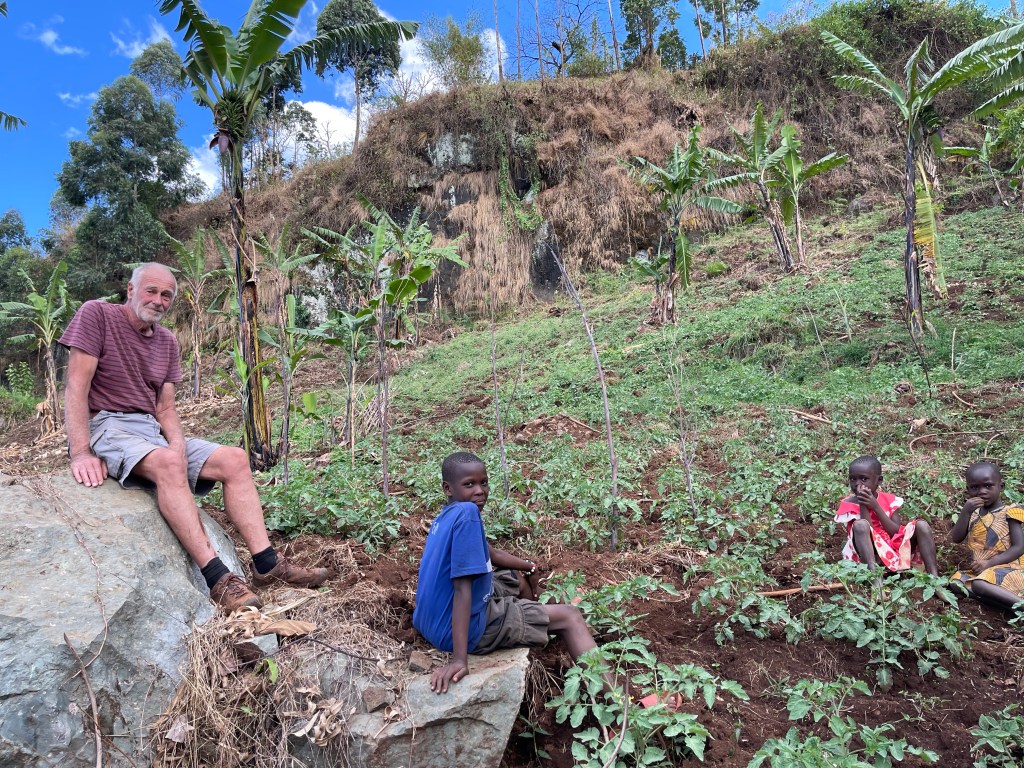
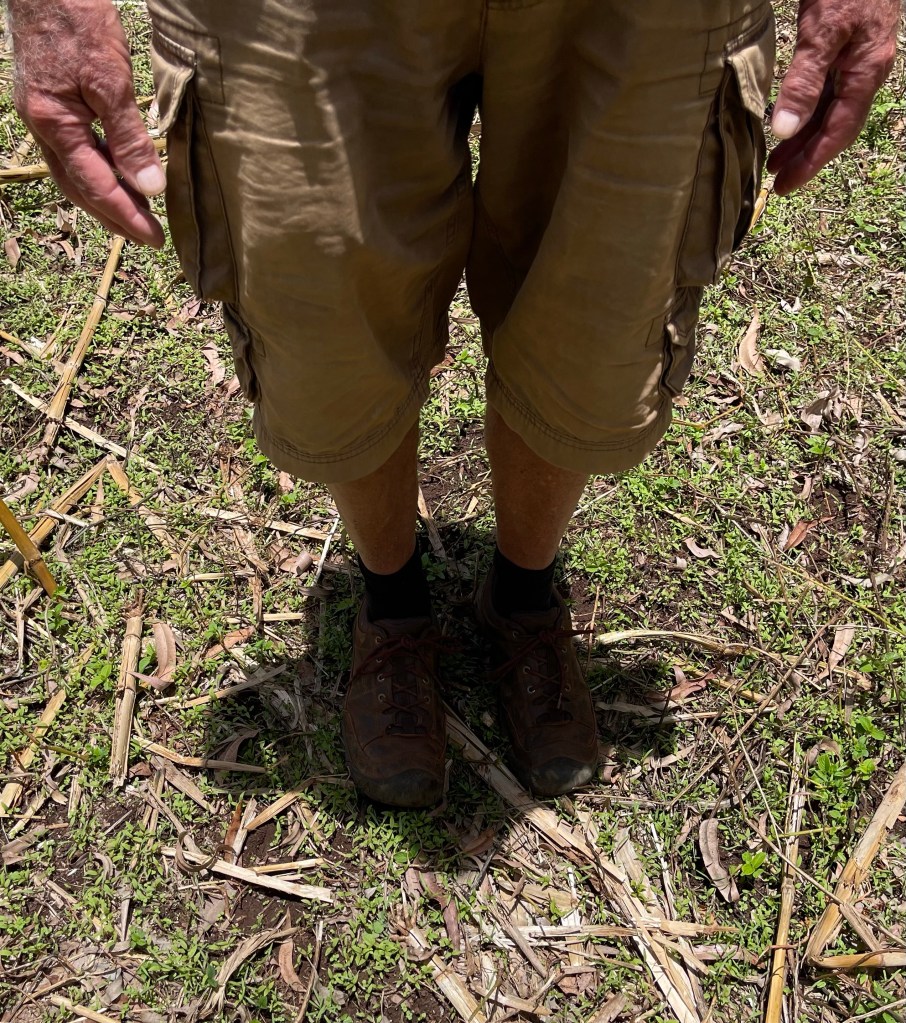
When you travel in these parts, the Equator becomes something of a feature. On some roads, I ride across it several times in just a few miles. Hiking at noon on the 22nd of March, 43 miles north of the equator, just 55 hours after the equinox, I asked William to take a picture. I really DO walk on my own shadow. Here’s proof:
****

A week later, as I bus through the highlands, it amuses me to watch one of the free apps on my phone, the compass that reads my altitude and location. We approach the Equator, tantalisingly slowly on the winding road, counting down the degrees, minutes and seconds of latitude and longitude, and the altitude.

Conveniently, latitude and longitude were invented in the old imperial days, and a degree of latitude is 60 miles so every minute is a mile (which, inconveniently, makes a second a 60th of a mile, 29.3333333 yards – revealing the clunkiness of the old imperial measurements).

Up here, we are very high. The bus grinds along in a line of labouring articulated trucks, matatus and the slowest of lorries. This narrow, winding main highway carries all the petrol and commercial traffic to Uganda and the interior of Africa from the coastal ports of the Indian Ocean still 400 miles away. The numbers count down slowly. The views are big, superb up here: forested slopes, dark conifers and flowering deciduous trees, high altitude meadows, giant vistas down to the south, red earth, and over it all, the cloud-dotted blue African sky. Women sit behind pyramids of delicately balanced red potatoes and cabbages like green footballs at the roadside. Most wear old mtumba anoraks and bobble hats, despite the extreme sun. To them, it’s cold! Could be down as low as 23/24°!

We make a sharp right curve and head south for five miles or so, through the straggly village of Timboroa. From here, the degrees count down at the speed of the bus: we are driving due south to the Equator. My phone tells me we are now at 2740 metres, 2750, 2760… At one and a half miles, 2790. One point two miles, 2820; one mile 2830; nought point six miles, 2840 (9318 feet). Then just 800 yards north of the Equator there’s a disappointing downwards tilt from this highest point on the road to Nairobi.

We cross the Equator at 2800 metres (still 9187 feet). The numbers, for just a moment, read 0°0’0”. We are 35°32’8” round the globe from the other invisible line through Greenwich. A tenth of the way round our planet. Amazingly, there are railway tracks up here. Those colonial Victorians certainly had ambitious confidence. The line’s being restored by the Chinese now: the next imperialists for poor beleaguered Africa. I saw a ten-car goods train lumbering towards Kitale the other day. With luck, it might get some petrol tankers off the high altitude road one day.

Then we are in the southern hemisphere. We roll past the village of Equator. Home, my phone tells me, is 4175 miles away. It feels every inch of it!

I wonder how many points on the Equator are this high? Was I up here in the metaphorical clouds that first time I bussed over the intangible line in Ecuador, fifty one years ago? I wonder how high I was on the Pan-American Highway on my way to Quito, itself about where we are now, 9350 feet?

Fifty one years… Ouch. Brian Tammen – a long haired, blond young American. We travelled together for a few days. We shook hands with portentous gravity as the concrete globe on a cement pedestal whipped past the third class bus window. I wonder where HE is now..?

Fifty one years. When you’re young, you never imagine being old…

****
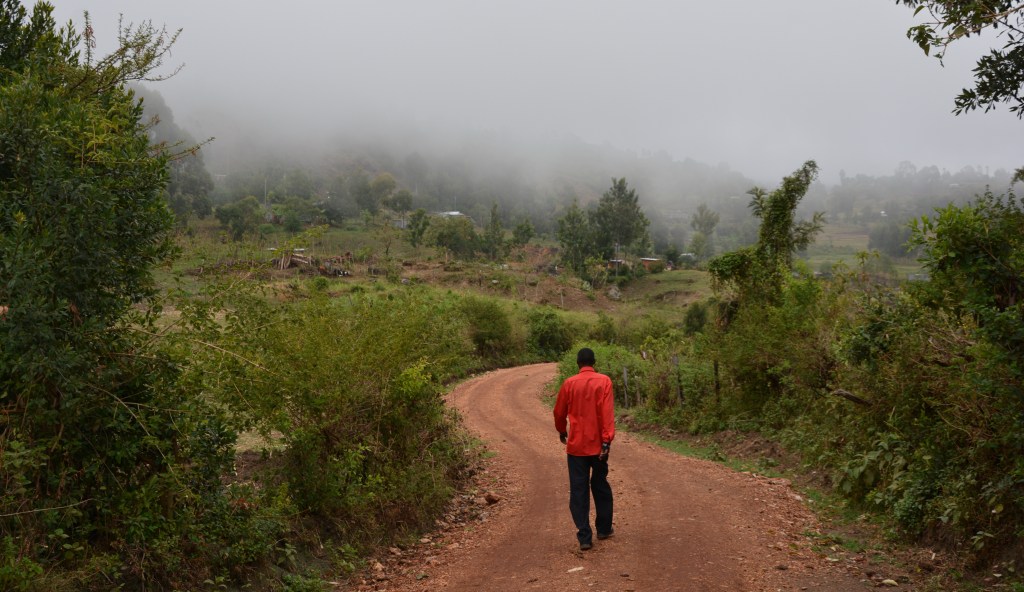
William walks in the ‘hanging valley’ on a damp morning

Let me go back. A few hours after the equinox on the 20th, found me hiking into the Kerio Valley, down again to the burning equatorial depths, home of the world’s best mangoes and one of my favourite bits of East Africa.

There’d been rain in the night, quite heavy, machine-gunning on the tin roof of my room on the lip of the great valley. Clouds hung like fog above and below the Kessup plateau, which William calls the ’hanging valley’, a thousand feet down the wall of the Great Rift. It made for cooler walking.

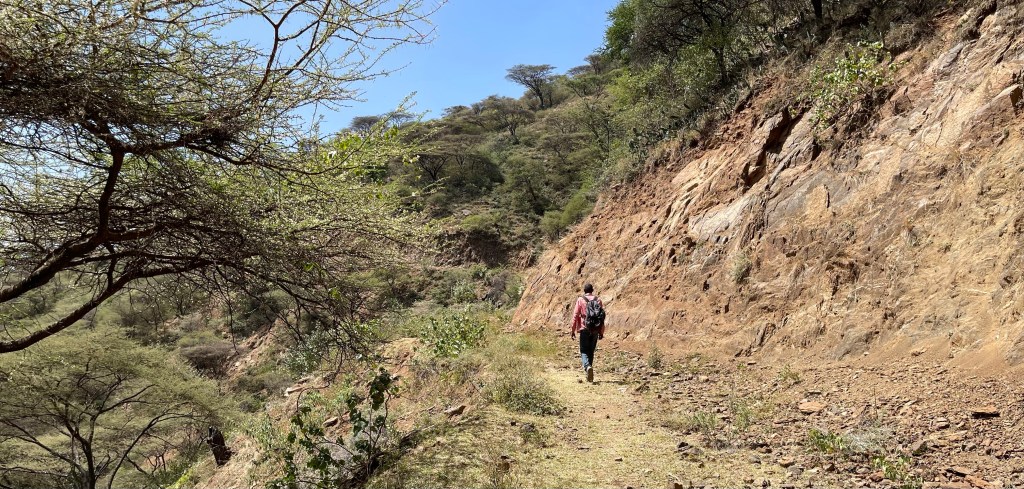
William and I could march along, using the putative road to the valley, which somehow ran out when the contractors hit 850 vertical feet of friable escarpment wall. William says cynically, “Huh, some officials made a LOT of money from this road!” The ‘road’ doesn’t actually exist, running out eventually and we must take to a steep slippery footpath and stumble down to where it starts again. The project is perhaps six or seven years old and already turning back into a goat track.
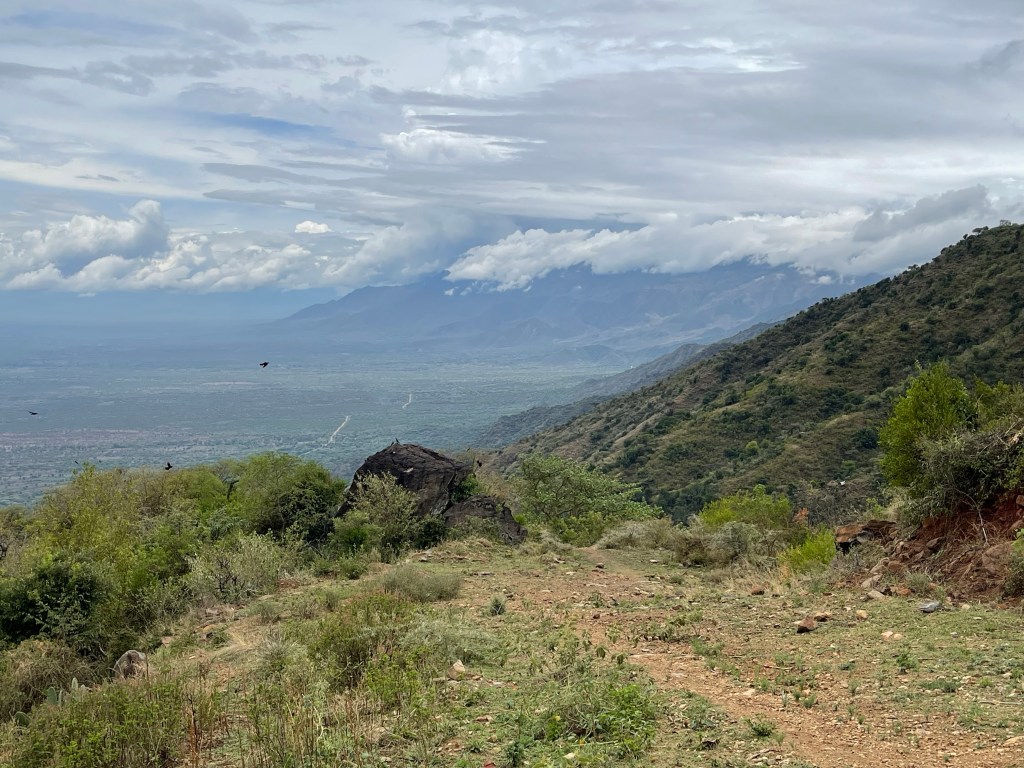
Soon, this will revert to a goat track. This is the end of the upper section of the ‘road’

****

We stay down on the Rift Valley floor, 2700 feet below Kessup. At least the heat of our last stay at Kipkoiywo Guest House has dissipated a bit. It’s just HOT now, not burning hot. But the start of the rains has brought out multitudes of flying ants and other insects. There are vast numbers of beetles on the ground, long black ones copulating furiously, small fluffy scarlet ones bustling busily, and many more. And this evening in the hotel yard, attracted by the light, I am plagued by flying insects by the hundred.

Beside my bed in the extremely basic guest house (and remember, I’m a connoisseur!) I find a crumpled leaflet.

Kipkoiywo Guest House is the combination of innovative design and crafted luxury and set apart by an unprecedented level of personalised hospitality… We combine comfort, personalised service and bespoke journeys… Exceptional values… Full time water availability… This is a place that is fun and filled with the unexpected…. And mindful that less is so often so much more.’
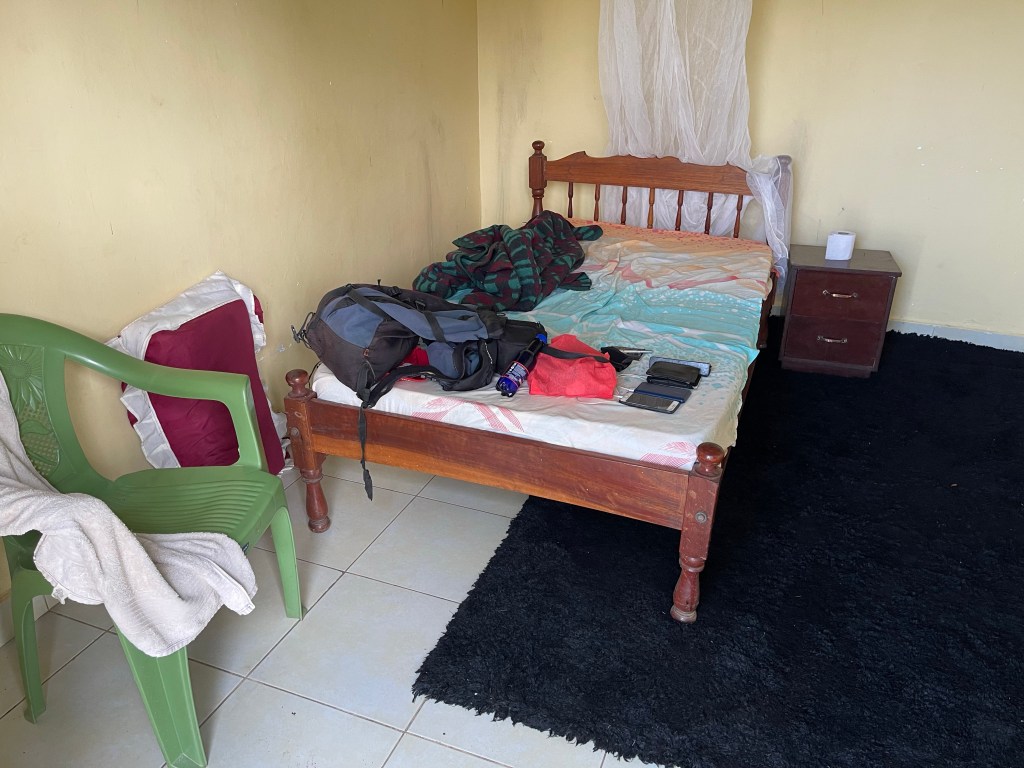
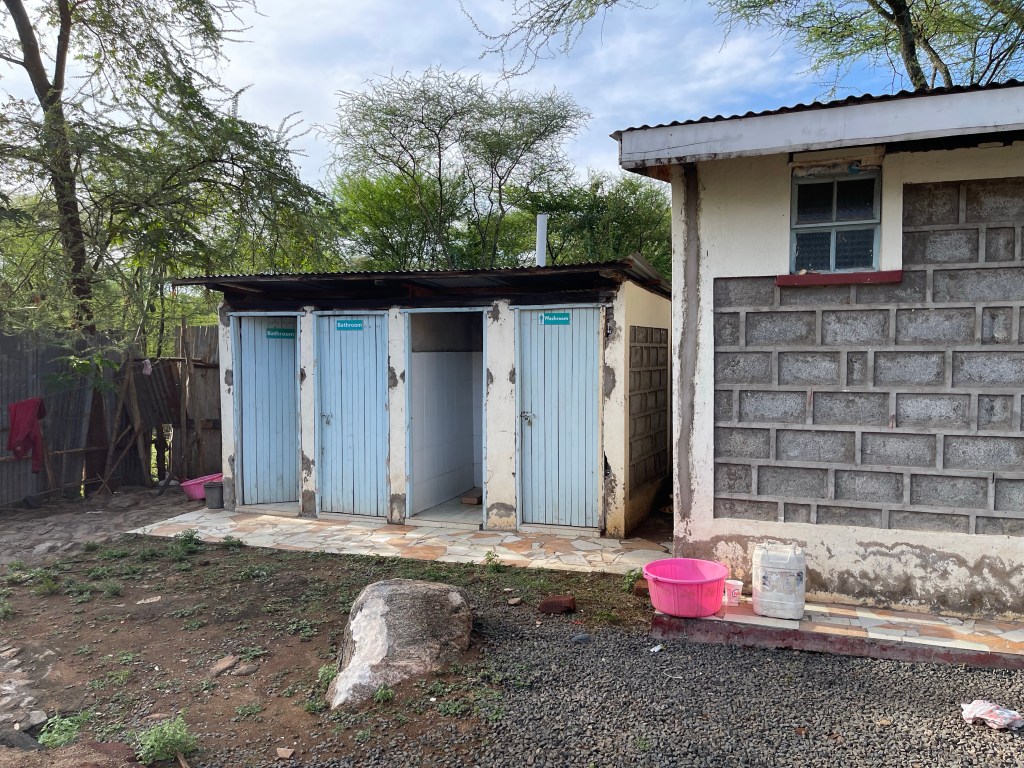
‘Crafted luxury’…

‘Innovative design’…

Actually, of course, less is often so much less. It’s a block-built hovel like all others, where the surprise is that there’s hardly any food available, no drinks; the rooms are completely basic: a bed, plastic basin and a pillow made from old foam rubber blocks. There’s no water except a battered jerrycan. The bathroom is an unpleasantly grubby unwashed latrine; the place is bonfire hot and bakes beneath tin roofs. For breakfast, if you’re lucky, you might get a couple of dry chapatis and black tea. Crafted luxury! ‘Your dream holiday destination’. Indeed… Another broken African dream; big plans, no reality.

****
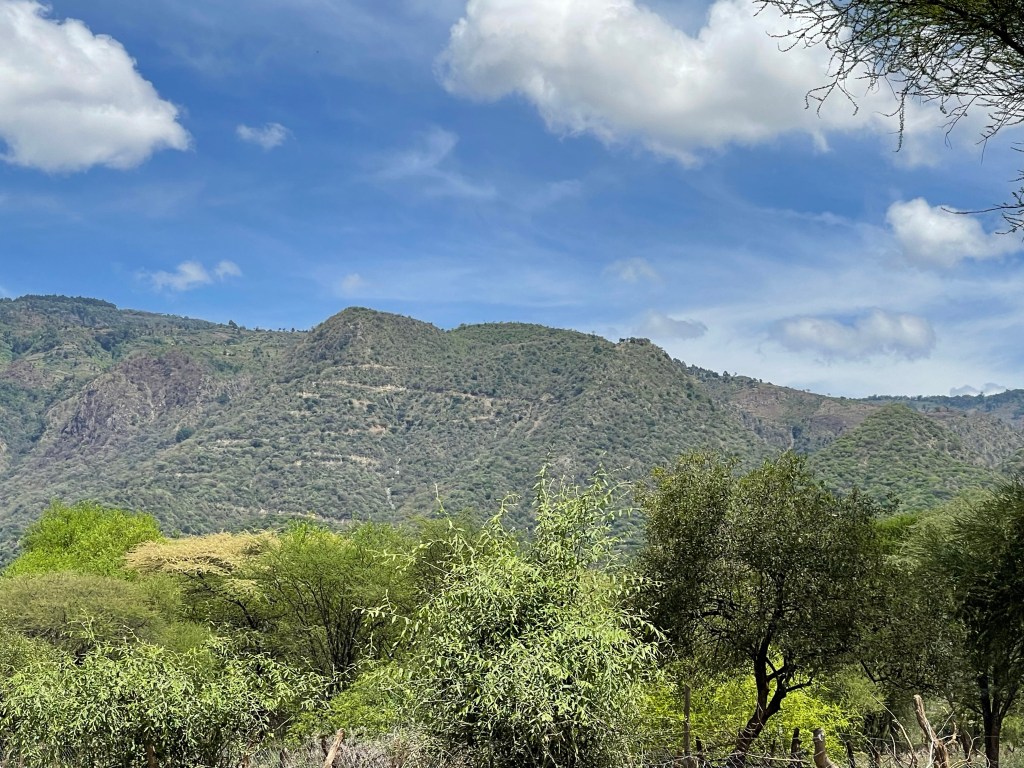
Zigzagging upwards…

There’s not much to stay down here for, except the luscious mangoes. We’re really here to climb out again. Odd behaviour, unless you are addicted to hard hiking and have experienced that view of the huge valley expanding below as you clamber up its side. The routes up are impressive, but perhaps the Kabulwo track is the best way back up that we’ve discovered so far. We did this extreme climb two years ago. It was even hotter then. It’s terrific to see the snaking track zigzagging across the wall-of-death mountainside. From up above, it’s remarkable to see the spaghetti bends curling through the green carpet of growth below too. Like yesterday’s track, it’s deteriorating through lack of maintenance. Left as it is, it’ll become impassible again.
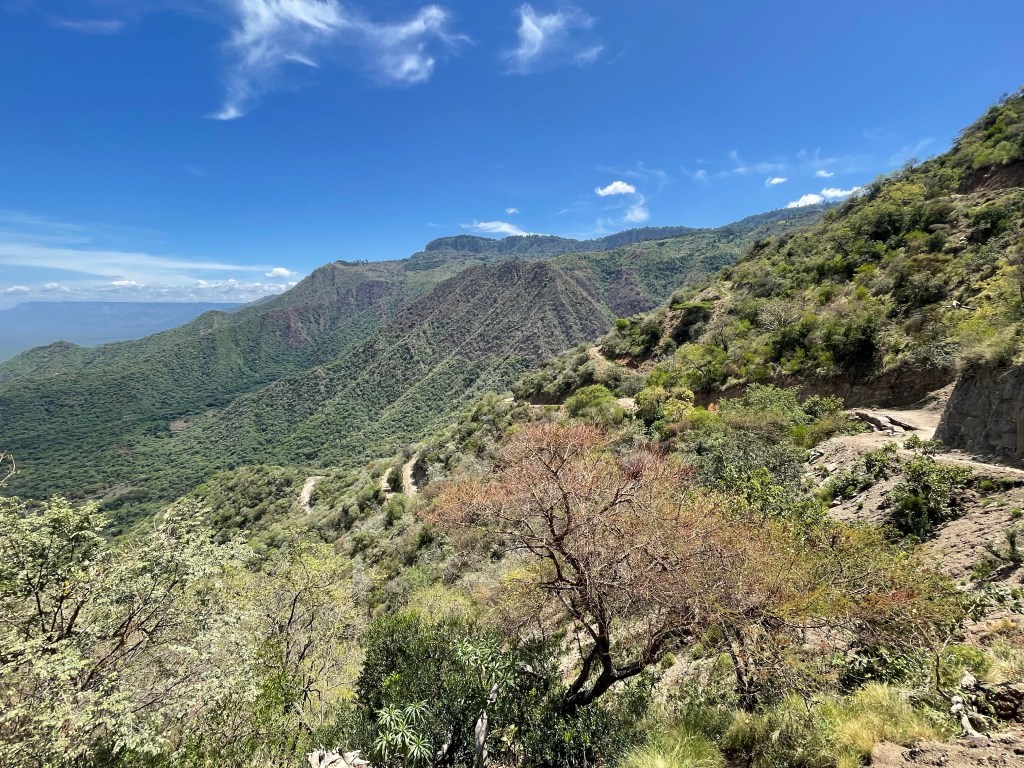
I climbed ALL that!

We clamber and climb, sweat and plod. There’s almost no metre of the track that’s not uphill. Two thirds of a degree from the Equator we are like indelicate ballerinas caught in a burning follow-spot on an unbelievably massive stage.

It’s one of our hardest hikes, not because of the distance, but because it is relentlessly uphill. From Kabulwo to Salaba is only a little over eight miles – but it is an immense 3480 feet in altitude! It’s exhausting. We start at an altitude of 1160 metres (3806 feet – higher than Snowdon) – and climb a further 3480 feet, which is almost as much as Snowdon. It’s like putting Snowdon on top of Snowdon! And then climbing the upper one…
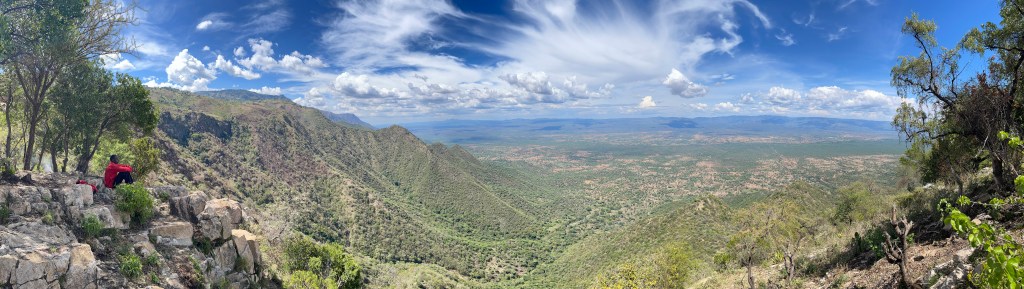
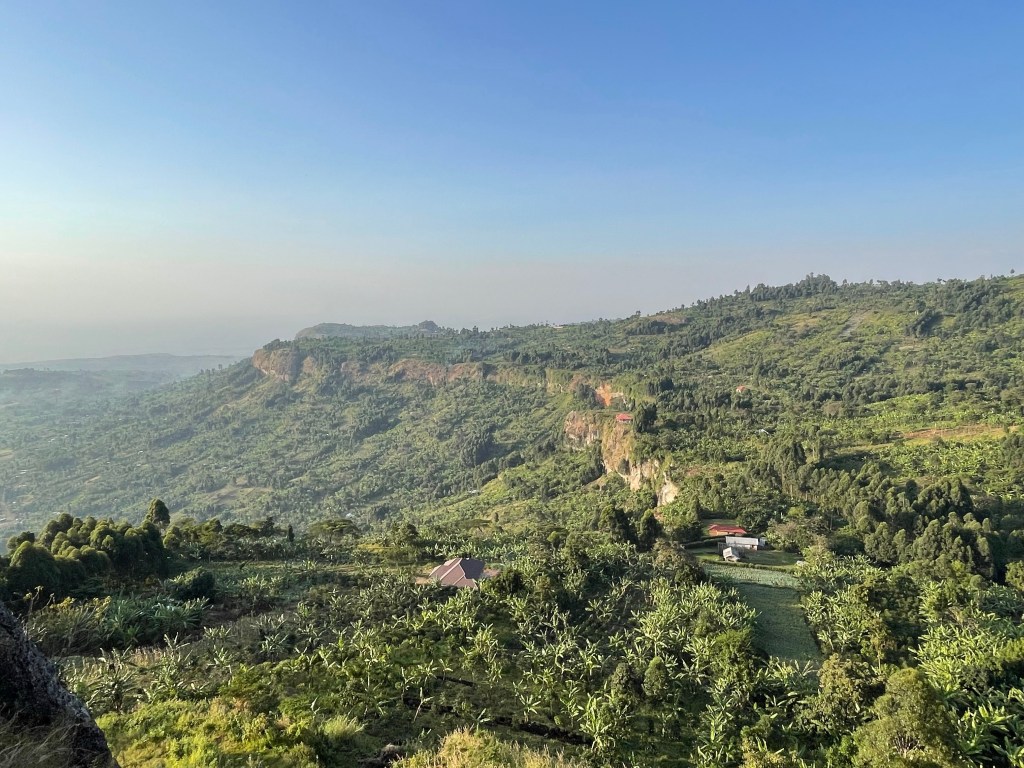
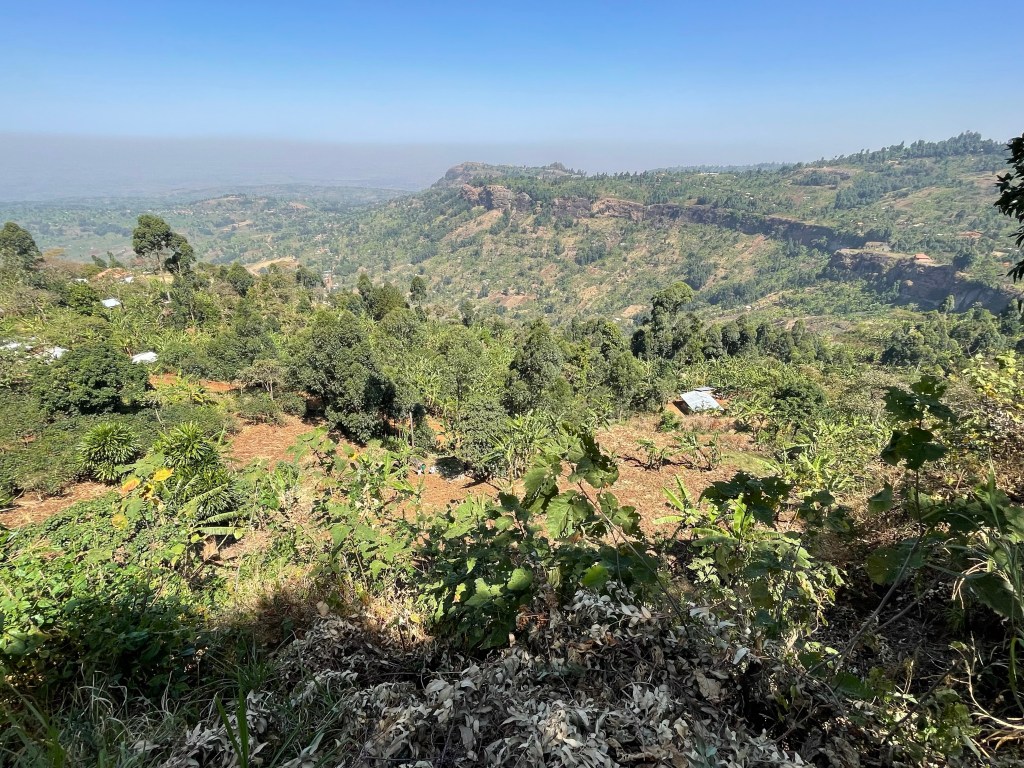
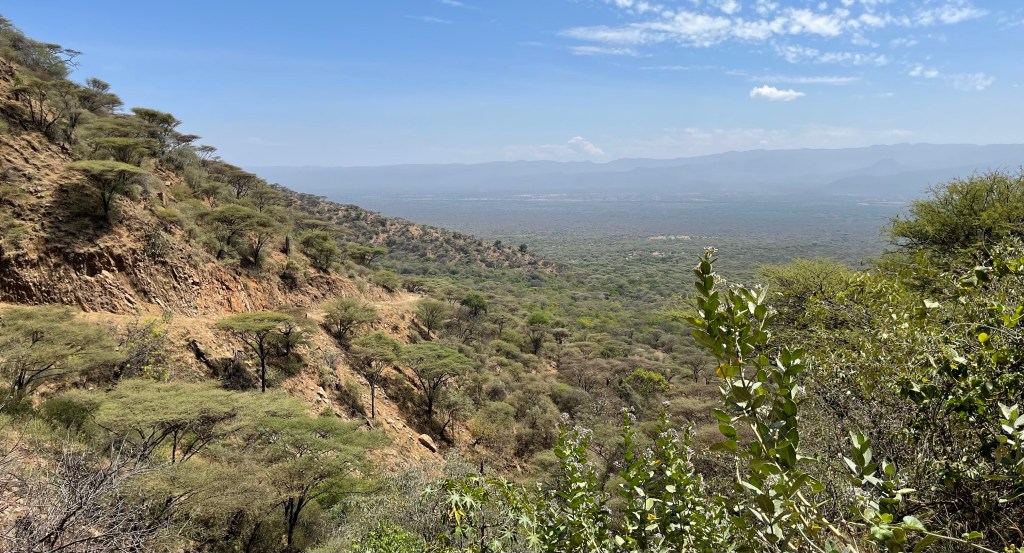
Worth the hike. A panoramic view of the northern Kerio Valley

The effort is worthwhile for the reward of the expansive view of the northern end of the Kerio Valley, looking towards the huge dryness of the Turkana deserts – birthplace of mankind – that is suddenly exposed at the top of the main rise. Unfortunately, there’s a surprise in store though. There are another six kilometres to pant and plod from here to the ‘hanging valley’ road – all uphill.

By now, even William is tired and slowing. I’m struggling. But at last we reach the ‘main road’ – another gravel road snaking across the hills of the here narrow hanging valley. It’s a fine track, one of the finest – I took it a couple of years ago on the Mosquito, a very memorable day’s ride. The African blue sky stretches overhead and as the sun lowers in the west it defines the shapes and contours, its warm light enhancing the colour palette after the bleached quality of the day here, so near the Equator. The shadow of the escarpment slides across the valley floor, away from us up on its western flank.
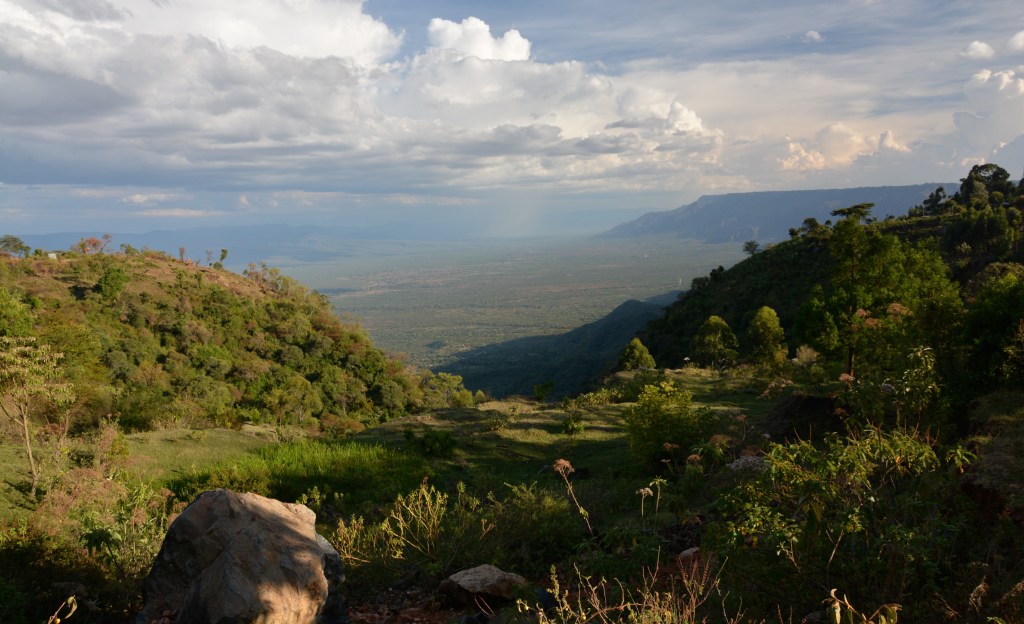
We hail a boda to take us back to Kessup, ten miles away. Now I can gaze down – from the back of the excruciating hip-cramping boda, and feel satisfied that today I have hiked from that distant valley floor to these dizzy heights.

It IS getting harder, but I’m still bloody-minded enough to do it. A three and a half thousand foot climb in eight miles.

****

That was Friday: an arduous day. To keep the momentum, we hike again next day too. Even William is stiff and weary. He calls for a short day. I’m not disappointed, but I’m glad it’s he who makes the request!

We take a boda to Singore, high up along the escarpment, and walk most of the way home. It’s high altitude but largely downhill or flat. We visit William’s aunt in a rugged timber house on the cliff edge. He grew up here as a child, on the lip of the valley, going to a primary school several hundred feet below. Children play above sheer drops, but no, says William, no child falls off…
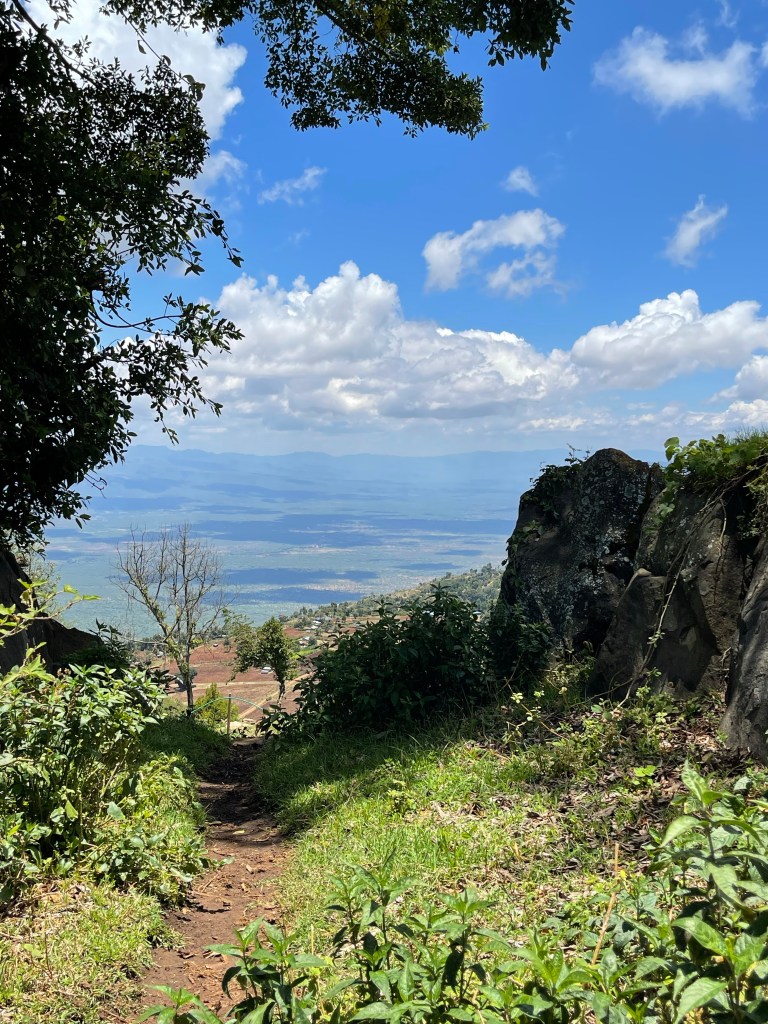
Beautiful hiking…

On Sunday, our legs loosened by the Saturday walk in Singore Forest, we decide to look for moratina. Of course, moratina is brewed up behind Kessup Forest, 1148 feet ABOVE Kessup…

The forest is cool and inviting, with high old trees, now protected by the government. Behind it, there’s a large cool plantation of conifers, then back to civilisation, Africa style – tin and timber houses surrounded by rough split paling fences, cows, goats and children, calling, “Mzungu! Mzungu!” I must greet and shake a hundred hands. How could I not? But sometimes (today being one) it just gets too much and I want to be anonymous and alone.

Of course, everyone’s friendly when a mzungu arrives, but they’re totally insensitive to my exhaustion after the 1150 foot climb and four miles from Kessup. In the past three days, we’ve walked UP no less than 3937 feet from the great valley! 7750 feet is HIGH! High altitude for one who lives 300 feet above sea level! Leave me to recover, fellows, and I can perhaps join in the joke. Right now, I’m merely so exhausted it’s not funny… Well, in a way it’s no longer funny anyway: I’ve spent almost four months being the butt of a million merry quips and friendly jokes. With the demise of the Mosquito, I’ve had no escape for a few days of reflection.

Bright yellow, I like moratina. With it’s alcohol content – probably about 4% or 5% – it’s popular on Sundays. I begin to relax. And smile at the goodwill.

Moratina is pretty much mead, said to be the oldest alcoholic drink in the world; fermented honey sometimes mixed with herbs or fruit, or in the case of the Kerio Valley, the ash of a tree seedpod. It takes eight kilos of honey to produce the forty litres of drink made in plastic barrels in this stuffy tin hut. Sounds like a huge sacrifice of bee effort, but then, no one here understands that human life can’t exist without bees, or the dangerous state in which they are currently suffering.

We drink our two Coke bottles of livid yellow alcohol, sitting incongruously on a velour settee. The men tell me that women aren’t allowed to drink moratina. I suggest that’s probably because they’re too bloody busy working – while their menfolk booze. They laugh at my idiocy, but the barb doesn’t hit home with anyone…

All the moratina, all forty litres of sunflower yellow sweetness, is gone by 2.30. Just as well we came when we did.

****
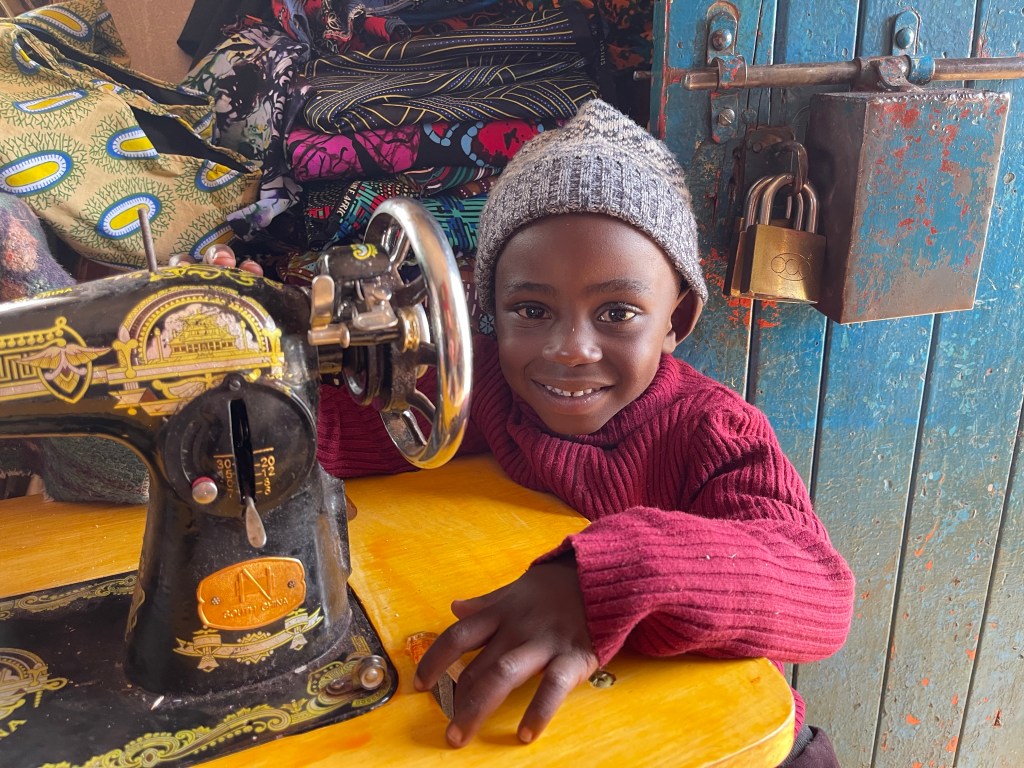
Jimmy Derek

I sleep better that night. Eleven and a half hours. Then I get matatus home to Kitale for the final time this visit. Adelight’s been pursuing her government contract to finish the two-classroom school building. She appears to be in her element, with a team of eight men on site, led by her junior brother, Tito. I can’t help hoping they finish on time and the government doesn’t make its usual delays and prevarications. A big chunk of my savings is involved. At present I technically OWN a lot of those two classrooms! My summer comfort, my lower teeth and hopefully a visit to Devon for Wechiga, all hinge on the government paying up in a timely manner.

Adelight’s team have been making desks for the school in Rico’s garage – from timber cut from the eucalyptus trees in the garden to save money. But this wood is so wet it must be soggy! There’s no such thing as seasoning timber here. One week it’s a tree, the next it’s a school desk, already curling and twisting.

Like most African ‘workers’, they’ve left the garage in a shambles, and walked away: wood shavings, rubbish and food wrappers littered everywhere. The rats’ll love it, and nails scattered on the floor foretells punctures. So Adelight and I turn to and blitz the garage.

I’ve been concerned about the value of Rico’s tools, specialist equipment and valuable instruments collected over a lifetime, now open to pilfering by any people with light fingers and big pockets. So we collect up most of the valuable items and lock them away in the cabinets and office. I drill holes in the cabinets so we can secure them with chains and padlocks.

In the afternoon, it rains heavily for the first time. The rains will now set in seriously. Time to move on.
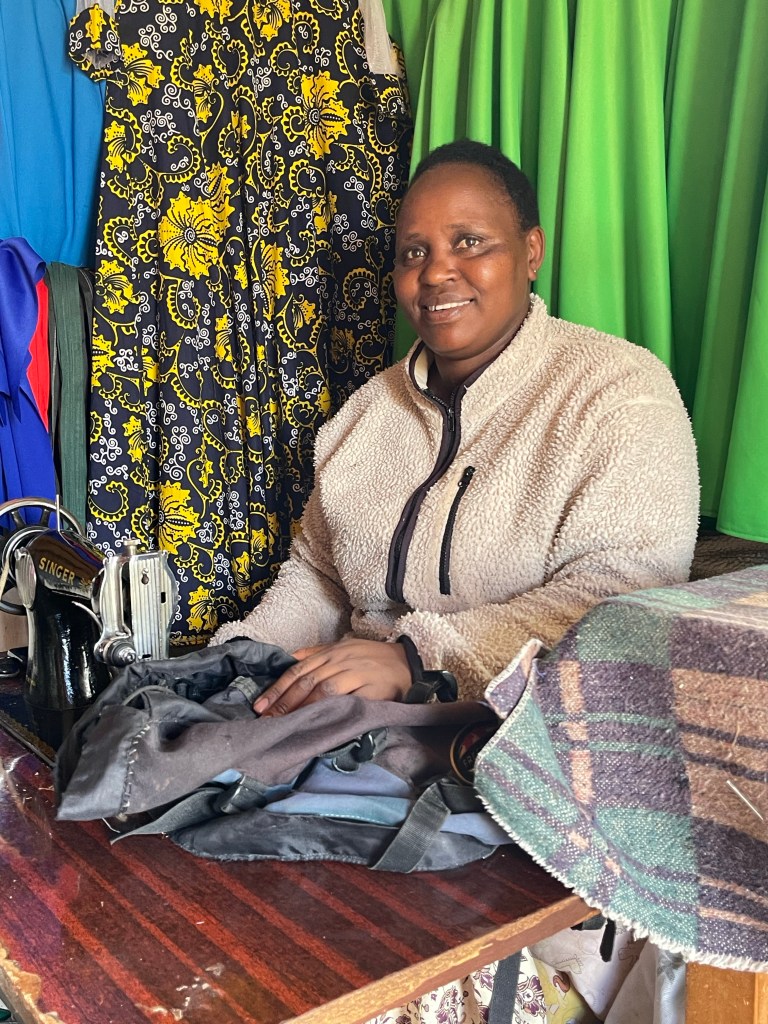
Jimmy’s mum, Susan, mends my old backpack, veteran of many trips. In England, they just tell me to buy another one…

****

I get the Mosquito running that afternoon. It’s my penultimate day in the highlands. I ride to town then a short ride out along the roads that I know so well now.

I realise that I still enjoy the little Mosquito… It’s perfect for my use: it’s light enough and tall enough that a 76 year old (next time!) can pick it up, and I can dance about on the roughest mountain tracks like a 30 year old. Rico adapted it for my use. He put on his own wide BMW handlebars, a comfortable seat for touring, a strong rack for my pannier bags. We adapted and maintained it for eight years.

A garrulous American missionary has introduced me to a possibly honest mechanic in Eldoret, 40 miles from Kitale. The Suzuki dealer in Nairobi isn’t so optimistic. It seems they too were guessing what the problem may be. “Don’t spend more money!” says the kindly Sikh Suzuki dealer. I have a lightbulb moment! Mano, Rico’s charming 24 year old grandson, whom I met back in December in Kitale, is a biker! And even new parts are half the price in the Netherlands. I’ll ask him to look for secondhand parts. He found me ‘an inspiration’, biking about Africa at my age, he’ll help! Maybe the Mosquito WILL live on..? To be continued…

Next day, I packed up my riding clothes, helmet and boots and put them all back in the big suitcase until next winter. In that action, I am assuming another safari… Well, I can’t face winter in Devon until I really HAVE to!

****
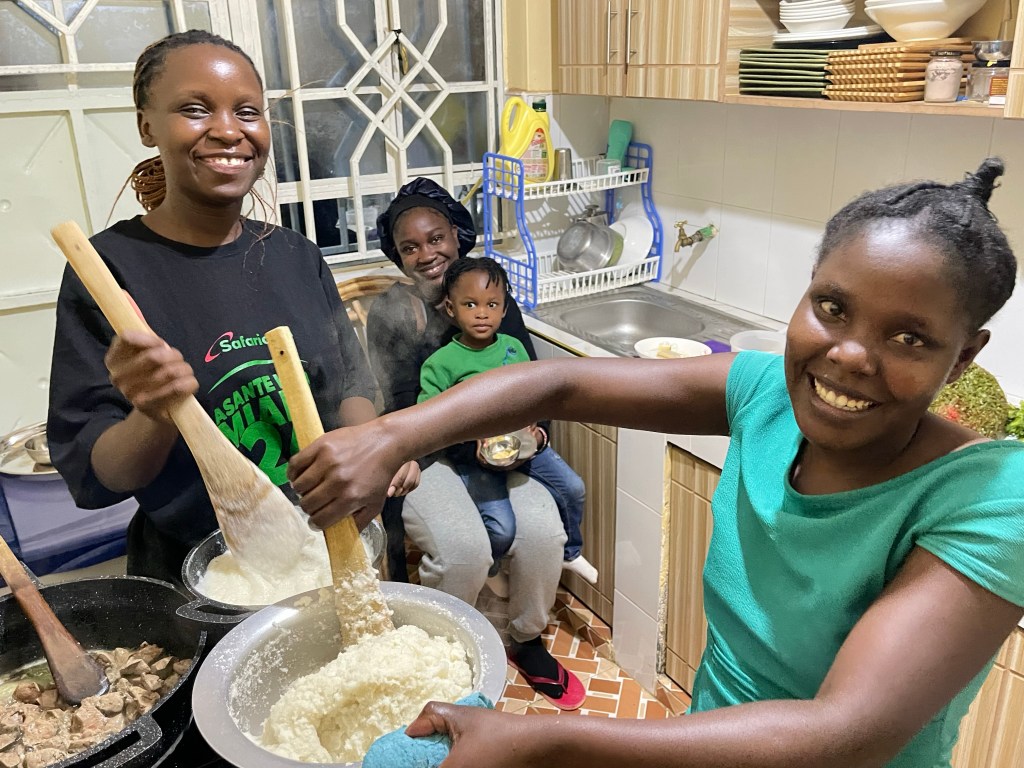
Cooking supper. Scovia, Marion with Deon, and Eunice, house girl. Ughali is the staple starch. Fillingly boring!

This journey has been all about seeing family, so I couldn’t leave out delightful Scovia and Marion. So, from Nairobi on a damp, grey morning I take a bus to Narok, southwest of the capital, a three hour ride. Up out of Nairobi and down the side of the escarpment, the windows steam up, there’s no view outside either, just a duvet of foggy low cloud. The expansive vista into the valley depth disappears into thick drifting rain cloud. Curio stalls cantilevered out over the abyss are doing no business.

The bus toils down the shelf road into the depths, behind grumbling lorries. A woman yells into her phone, sharing an hour-long argument with some unseen antagonist. Funny how people’s concept of etiquette and privacy has changed with mobile phones. Many seem quite unembarrassed to share their personal thoughts and disputes in loud voices with the world. A woman across the aisle shuts her eyes in Nairobi and goes into what looks like a meditative trance all the way to Narok. I envy her and put in my ear plugs. A child wails and screams behind me, the woman argues on in front. Ear plugs are such a relief. There’s no magic to travelling by public means in Africa. I think with fondness of my motorbike independence.

Narok is the nearest town to the famous Maasai Mara national park. It’s a tidy town, clean, with rare pavements. It’s bright and developing. Scovia, looking terrific in black and white – she’s such a pretty, vivacious young woman – meets me. Actually Adelight’s junior sister, brought up by her and Rico, I called Scovia my favourite African until I knew little Keilah so well. I first met Scovia on her 18th birthday eight years ago. Now she’s mother to Deon, an obstreperous almost-three year old, going through a ‘difficult’ phase. Happily, I’ve had the bright idea of inviting and faring Marion, her sister, to Narok too. Scovia’s husband, Webb, a congenial fellow, a chef for a smart hotel chain, joins us for a brief day off, travelling five hours through two nights to do so. Employment can be hard in Africa.

****

Long journeys bring personal analysis. Actually, it’s a relief to be alone just for a few hours on the way back to Nairobi.

I never say I’m too old for anything, but one concession might be African public transport. I don’t think I have the endless patience I had as a young traveller. It’s funny… it’s my dignity that suffers now. Where did that come from? Dignity? I’ve always been an impecunious traveller – dignity had no place in that. Personal space, respect, status? Maybe I AM finally getting old? Certainly less patient and more crotchety.

And a bus, the back of which is filled with noisy, disrespectful, obviously privileged schoolgirls with the olfactory hint of teenage girls in polyester football strip isn’t easy. I poke in the earplugs and read my book. It’s the only book to be seen. There’s NO habit of reading in most of Africa, with the competition of minuscule attention spans as everyone surfs their phones for stories curated and interpreted by other imaginations. Alex jokes, somewhat ironically, given that HE doesn’t read either, “If you want to hide something in Africa, put it in a book!” How sad that imagination is stultified thus.

I read, buffeted by a 15 year old heavyweight schoolgirl who gossips with all the children around her. She’s pissed off with me because she was sitting in my seat, saying rudely, “You can sit over there!” only to be overruled by the conductor as all seats are full today. It’s a sudden bank holiday – Eid, the end of Ramadan. So buses are busy. She ignores me studiously for four hours. These sons and daughters of rich Africans are the worst: they grow up with a sense of entitlement and superiority in their poorly educated, impoverished homelands, arrogant and belittling their ‘inferiors’.

Across the handsome rolling hills, we reach the base of the huge slope. It’ll be ten miles or more of laborious climbing. And even I could probably outrun the heaving trucks up this long incline, as people overtake perilously, apparently oblivious to the expanding views over the increasing drop to the south: straight down, as much as it matters. Nothing beyond the frail steel barrier to prevent the long plunge from any error of judgement.
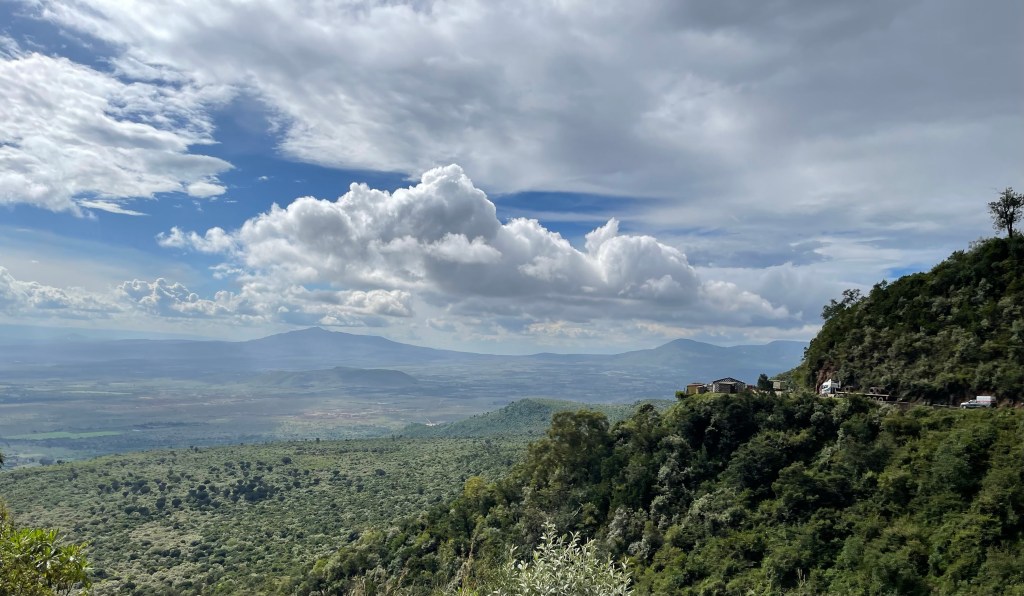
Not much to stop a plunging vehicle but a frail barrier rail

I can’t ever quite forget that I have – TWICE – somersaulted through 360° in buses just like this. A rare and unenviable record in my travelling life, I hope. I’m probably the only passenger actually using a seatbelt. No one imagines that big coaches can somersault. On both my previous acrobatic buses, the seatbelts were broken. I have the broken nose to remember the first one, slightly more visible with age, a 51-year battle scar. It’s interesting to think how formative a life experience that first accident was, without the pervasive internet to share my shock and be comforted by words of sympathy. The world was SO big then. I had to deal with shock, broken ribs and a broken nose on my own. And next day, I had to get back in buses and continue on earth shelf roads through terrifying Colombian mountain ranges. On my own. Lugging a rucksack with my broken ribs, a few painkillers from a local hospital my only comfort.

Astonishing that it happened again, some 35 years later! As we tumbled through space, all wheels off the floor, a rainbow of glittering window-glass shards cascading through the air mixed with shiny drops of tropical rain, I remember thinking, ‘Oh no! Not again! Not TWICE’.

I gaze into the abyss beside the road with some discomfort…
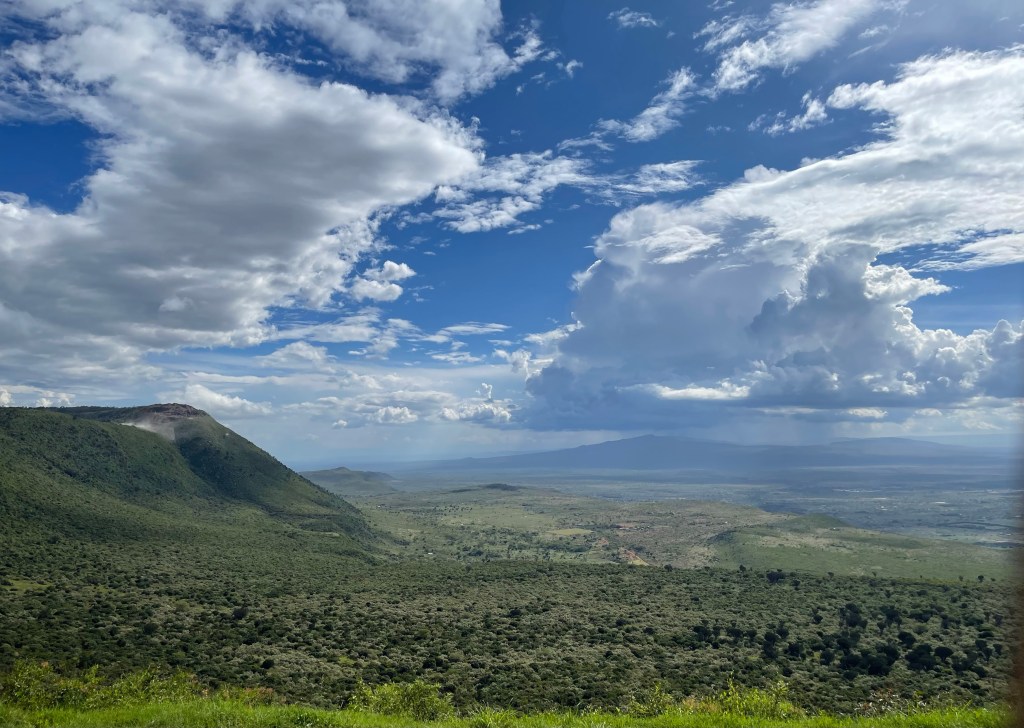
The Rift Valley, west of Nairobi. One of the sights of East Africa

****

My dignity affronted, I reach Nairobi. This is no city for any dignity at all! It’s crowded and chaotic with almost no provision for pedestrians, just oversized killer cars driven by entitled men, probably fathers of those rude schoolgirls. It’s no fun walking in this city.

I’m known well at the old fashioned United Kenya Club now. I have my usual rooms and my usual orders. I quite like this familiarity. I hope not too many tourists find this place. Maybe it’s too old fashioned for them. Tonight, people complain how cold it is… It’s 22°!! I’ve asked for a lighter blanket to replace the duvet. Ultimately, I sleep with just the sheet. Room service are shocked.

****
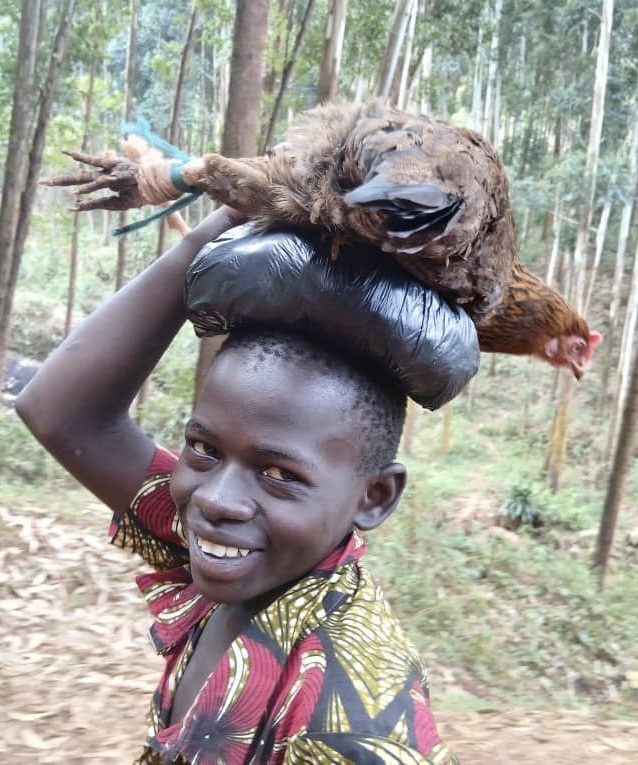
Alex took this picture of a chicken hat

Alex rings to say he’s been planting at Chelel, our newly purchased coffee fields. He’s already started constructing his coffee house and is moving forward in his determined, optimistic fashion, but he says that Keilah burst into tears not to see me at school last Sunday.

****

Adelight WhatsApps to say she’s meeting the inspector to sign off the school work and start the process of payment. Let’s hope the government, not known for straightforward dealing, keeps to their bargain. It’s that or continuing with the bloody temporary denture in my bottom set, I remind her..!

****

William rings to say farewell. “We’ll challenge ourselves to the valley again next year!” he declares cheerfully.

****

Sitting here writing in Nairobi, I wonder about homecoming.

This has been a different trip to any other. I haven’t been my usual peripatetic self. Partly, this was owing to the Mosquito, but also to the interesting fact of my discovery of Family. The strength of commitment to my African families (and I must never forget my closest brother, Wechiga, over in Ghana) has become a defining feature of the latter part of my life. It’s an unbreakable bond. It seems natural to be here now; in some ways THIS is the norm. Going home brings all the familiarity that is comfortable and easy, but so much of my thought and emotion is in Africa now. It’s a surprise how powerful these emotions have become, and this visit has enhanced the closeness.

By tomorrow, when I fly out, I’ll have spent 117 days in Africa. 54 in Sipi, 34 in Kitale and 14 in Kessup. I’ve found a purpose in helping Alex to flourish, in lifting Adelight to independence, and in his small way, William to call himself a ‘dairy farmer’ with pride. The children, especially Keilah, have been a source of the greatest delight. I didn’t expect THAT ‘at my age’.

I am now responsible for the education of Keilah and my namesake, Jonathan Bean. My privilege in being a Baby Boomer gives me a comfortable and relatively easy life. I never really felt the money was mine – and now a good deal of it isn’t! Haha. It’s earmarked for people who have so much less access to our comforts and financial security. It seems fair to me.

****

Yesterday… Alex called to say he’d been offered half the plot next to our Chelel coffee field! He’s agreed to purchase! It’s a good bargain: just 4,000,000 Uganda Shillings – about £900. His neighbour needs to raise money for two children to sit their National Exams, and like almost every Ugandan, has too many children and lives for the day, not realising that once sold, he can’t profit from his land again.
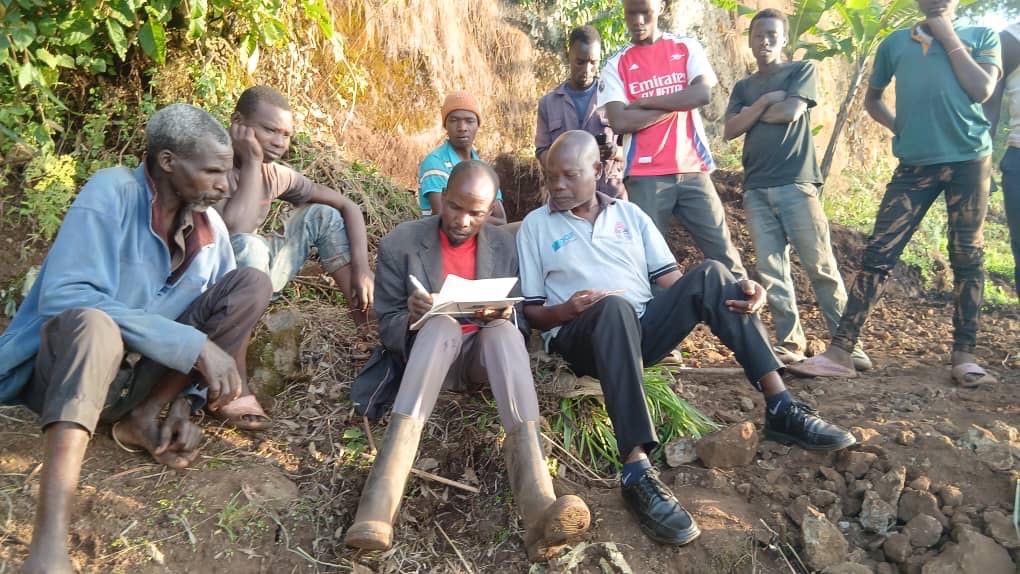
Alex takes a picture of the sellers and clan chiefs as an agreement is signed for half the neighbouring plot

I can only chip in £250 today; Adelight has the rest! Somehow, my determined young friend, as close to a son as I’ve got, raises the rest. Who knows how? It’s that truly African mystery… He’s a man of property. In Africa, there is no more valuable asset. I’m very deeply proud of him.

I fly out late tomorrow night. The forecast for Harberton is for full sunshine for the weekend. I had a feeling my extra month might pay off, after the misery of returning to dull rain and darkness last March. The clocks have gone forward. Everyone will look at me, tell me how very fit I look and tell me I’ve brought the sunshine from Africa.

I think ‘Sunshine’ is what I feel too…
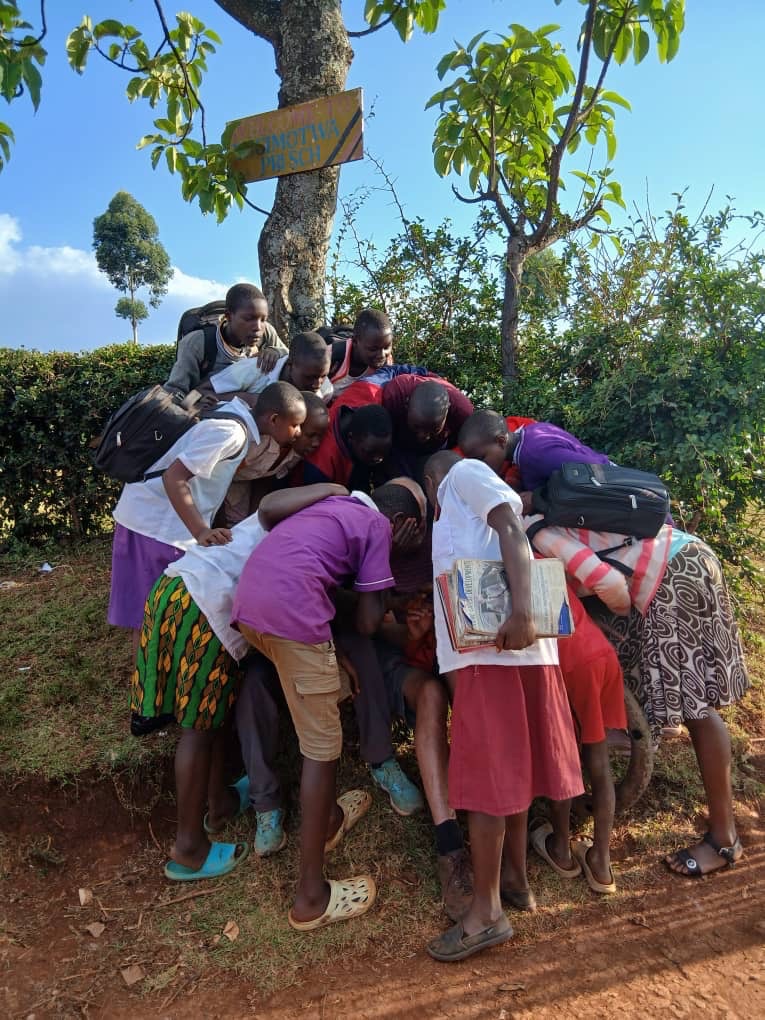
Look carefully and you can see a small arc of white head!

For Samuel and Robert in rural Uganda, I was the first mzungu to pass their home – ever…

My favourite photo of the year. Keilah, my wonderful granddaughter

Thank you for reading my blog. I hope it’s informed and opened your heart to Africa. For me, as must be obvious, there’s nowhere like these countries on this always surprising continent…

JB 2 April 2025

EAST AFRICA 2025 – EPISODE SIX

MARCH 18th 2025
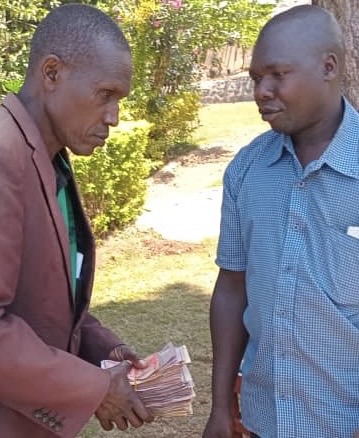
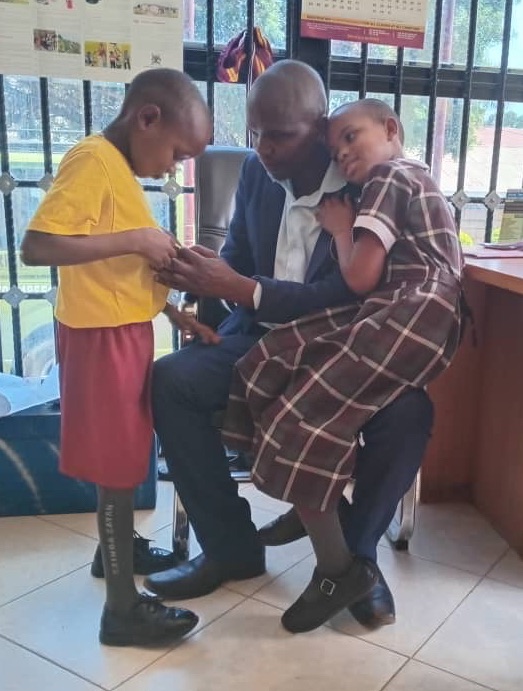
Jonathan gets his school shoes repaired

To reenter Kenya yesterday, I had to buy a new visa. It’s an online application, tedious and arcane, but probably invented by the British, who make such bureaucracy FAR more complex and eye-of-the-needle for my black-skinned friends. I paid with my credit card. Later, I checked the payment.

Guess where the money went – some £25 of my hard currency?

Not the Central Bank of Kenya, but to Neufchatel, Switzerland! – a Swiss bank account.

Intriguing. Under the current president, William Ruto, Kenya has taken many steps backwards to become recognised as one of Africa’s more corrupt governments. But more on endemic East African corruption later…

****

Visiting ‘my’ coffee field, meeting the neighbours

“The rains start on March 10th…” I’ve been told this many times, and it’s the reason I leave East Africa about then. Last year, I got back to Devon on the 12th to find everyone utterly miserable: “It hasn’t stopped raining since you left…” said with despondent misery. Within a week of being trapped in Rock Cottage by dreary drizzle, darkness and chill, I too was miserable and decided right then to stay an extra month in Africa this year! After all, ‘at my age’ I have to make the most of every opportunity, and why be miserable?

But I have a quandary. On a filthy wet day in Uganda, the mud – and the rain, cascading off the corrugated roofs – are wretchedness itself, somehow more difficult to bear. At home I can turn up the heating, turn on Radio Three and eat cake. Here you slosh through cloying red mud and rain waterfalls on your head. There’s not much escape. Happily, the rains are slow to build this year, so my decision is still in my favour – just. On the 9th, we had heavy showers; on the 10th steady rain, on cue. Then several days with no more than light showers here and there. Some of the recent days have been oppressively hot and sunny as the humidity increases.

I’ve just got back to Kitale, where the afternoon thunder roars and frets overhead. Will it rain? Probably a shower. It won’t yet be the concentrated downpours that will come soon. When it rains here on the Equator, it REALLY rains! You don’t want to be on a motorcycle.

****

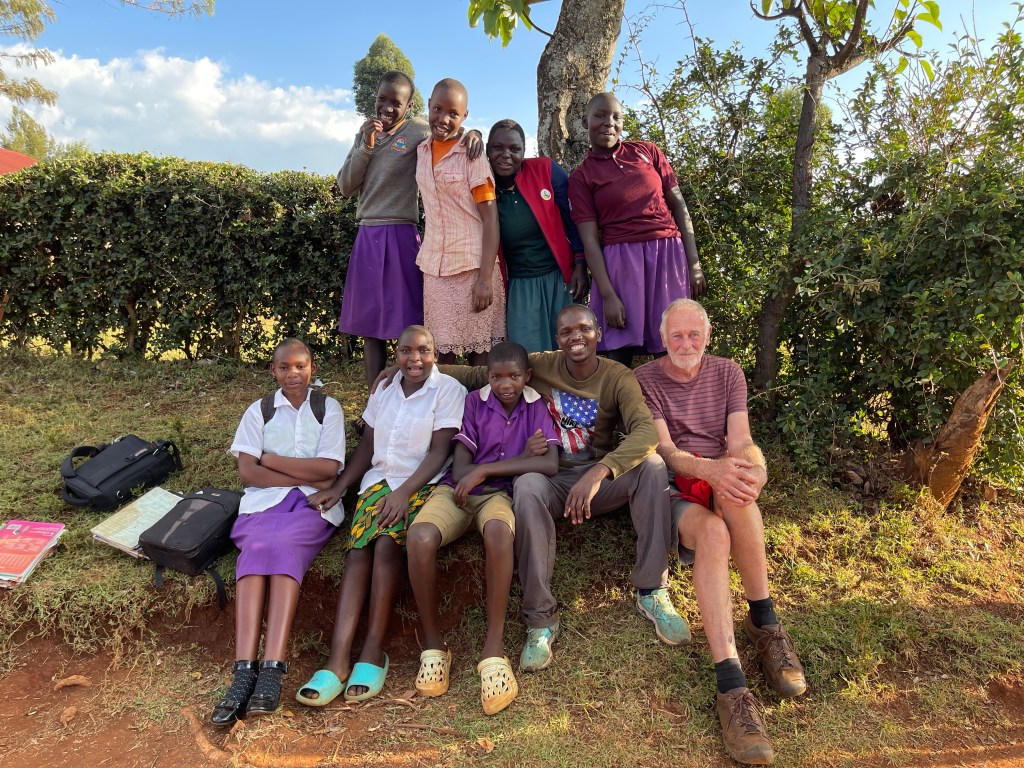
Alex with excited schoolgirls meeting their first mzungu

I’ve been in Uganda all the time since I posted my last episode. Of 100 days so far, I’ve been 54 in Sipi. Alex’s building bonanza of 2024 means there’s been plenty to keep me busy.

Room JB3 with its new paint job

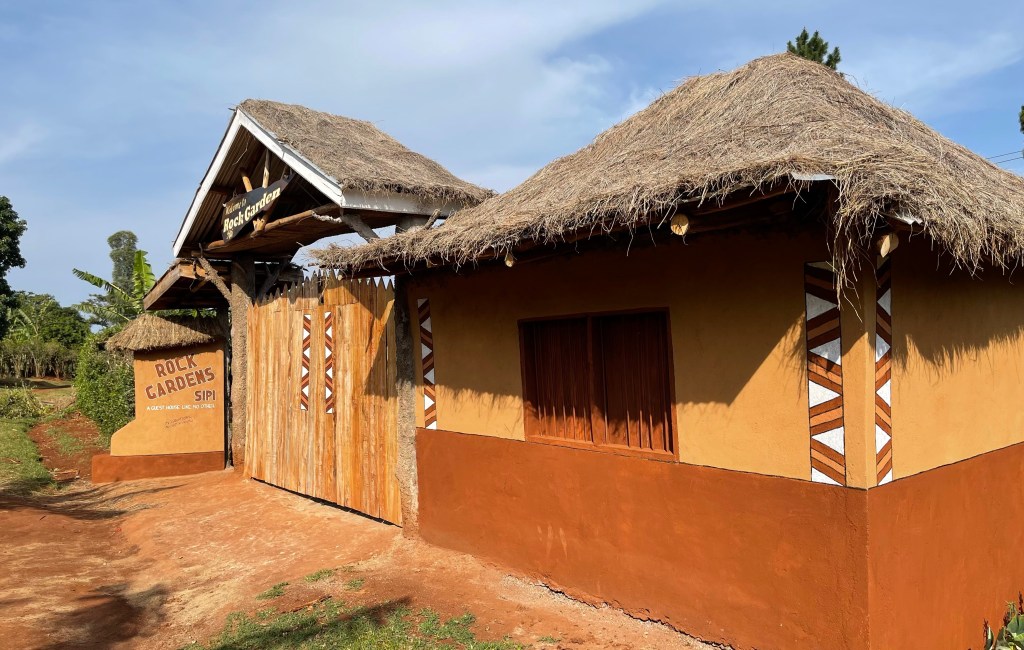
The gate to Rock Gardens, given some presence from the lane

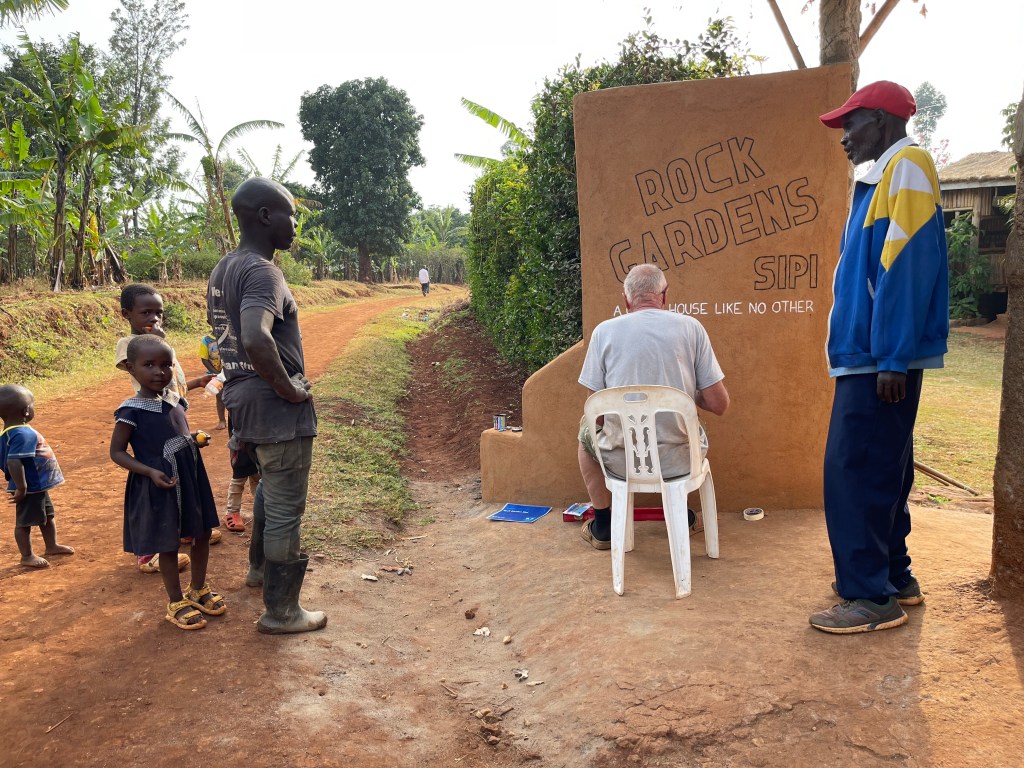
Sign writer at work

Always an audience of children

This length of stay has exposed to me some underlying realities of Ugandan life, aspects that tourists coming for the animals (now largely behind protective fences) and the increasingly staged ‘tradition’, don’t witness. Much of this underbelly is not attractive. Such friendly people in a beautiful – but often shitty land and a moral vacuum.

The appalling leadership – Uganda is run as a Family Business by the president and his relations – has made Uganda a dog-eat-dog country. “A very behind country,” as Precious once termed her homeland. All fight and compete for the scant resources left after The Family creams away all the riches to their own – doubtless Swiss – bank accounts. With such leadership as an example, just about everyone – with rare notable exceptions – is corrupted, lawless and grasping for a lifebelt as they drown, often fighting for others’ flotsam to keep their heads above water. Nothing is done in community spirit, only for payment. I’ve heard so many appalling stories of lawless, amoral Ugandan behaviour that I feel prudishly offended and disillusioned: tales of murder, revenge, rape, millions of unwanted pregnancies, attacks, clan rivalry, tribal hatred, fratricide, matricide, patricide, infanticide, jealousy, pride, ignorance and pure evil.

Uganda is an extreme African example of ignorance and immorality, although sadly not alone, with all the medieval horrors of of infanticide: unwanted children discarded into latrines, left to be killed by dogs, abandoned; men like randy animals having casual sex without responsibility for the babies or thought of consequences; of wives killed and disfigured by jealous husbands (with no morals of their own) for sexual misdemeanour in a place where sex is forced, demanded, raped. Of brothers pushed over cliffs for alleged interference with wives; of summary murderous justice meted out clan against clan; assassins hired by the government to seek out and kill; of rampant poisoning and mysterious ‘accidental’ deaths of opposition. It’s like a medieval horror fantasy, but it’s the underbelly of Ugandan conscience.

It makes me wonder – if this is really the sub-surface reality – why do I find Uganda so fascinating and attractive? And ironically this is where fate elected that I’d find a son and grandchildren… Only Alex brings a sense of censure and rationality to it all. Many still believe in witches and ignorant ‘cultural’ beliefs in this poorly educated country. Of course, I am bringing my own judgement and standards to bear, but the stories are gothic, and all around me. Stories of lawless revenge and shocking events apparently accepted and condoned as so-called ‘culture’…

I don’t think that the grandparents’ generations were like this. I believe it’s a relatively modern problem and less pronounced in more developed countries in which I’ve travelled: Ghana and Kenya for instance. Yes, the harsh punishments may still be there, but not the total lack of moral control. That’s modern Uganda, a poverty-stricken country controlled as a criminally despotic Family Business, with no moral example, where everyone fights for money and lives for the day, where no one thinks of the consequences for tomorrow, and is exploited as an emerging ‘market’ by uncaring capitalist corporations and their own leaders.

It’s interesting to note that overwhelmingly, these people profess Christian or Islamic beliefs…. Lip service to moral structures they certainly don’t follow.

Joshua trained as a nurse. He’s been shortlisted for an interview: a job with a salary of £270 a month. He has a small family and needs the work. “But,” he explains, “they will ask me, ‘when are you coming with your brother’?” I look mystified, until I understand that he means the bribe for the people conducting the interview. “This time, I won’t give them money until they offer me the job. The last job I applied for, it cost me one point five million (£335), and I didn’t get the work…” The job for the highest bidder…

Then there’s the phenomenon of ‘ghost employees’ and ‘ghost pensions’ – billions of shillings paid out for teachers, army personnel, nurses, and government workers either struck off the rolls, or dead, whose salaries and pensions go into the pockets of officials on the ladder above them. Marion was widowed by her soldier husband, but can’t get the pension to which she is entitled, because she has no clout. But someone, somewhere, is enjoying her pension… Shameful, shameful Uganda.

****

Great hiking country. But a lot of UP!

Debra, nearly a decade younger than me, is from Melbourne, a lawyer and long-time traveller, with a love of Africa. We met last year when she came to Rock Gardens with her charming young protege, Rebecca, an orphan from Jinja, down in steamy central Uganda, where the Nile slides out of Lake Victoria. She quickly and instinctively became part of the Rock Gardens family: ‘Auntie Debra’, and with me, supports Alex in developing the guest house – with financial help and good advice, her legal knowledge coming into use as Alex becomes a land owner.

Elio likes the bloody flowerbeds!

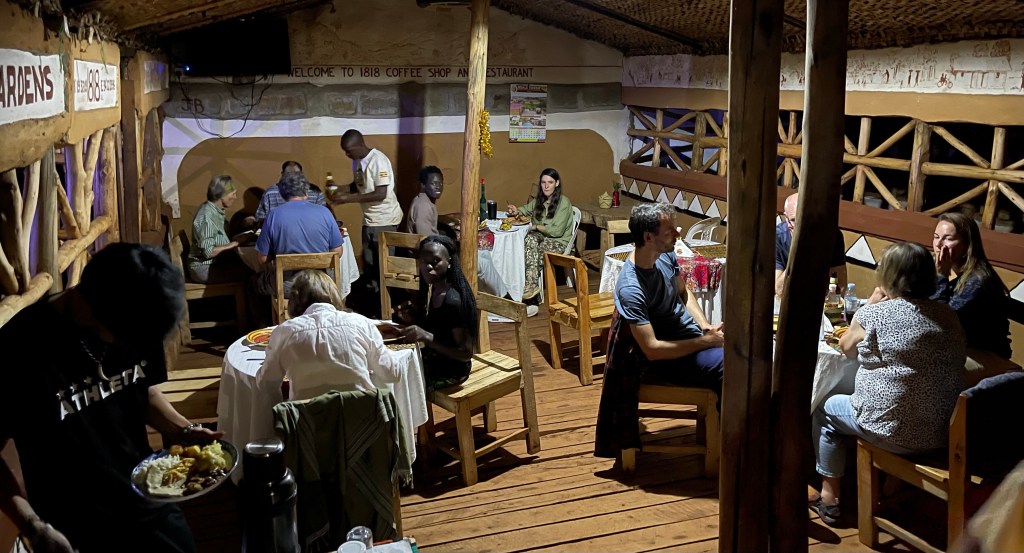
1818 restaurant on a record night of 19 diners

Rock Gardens is a success story way beyond my expectations. But travelling has changed so much since Debra’s and my early days of impecunious wandering to find out how other people experienced the world. The Internet Tourist is now on a merry-go-round (or treadmill) of Tourism, with a capital T. They come to Sipi, do ‘The Waterfall Tour’, ‘The Coffee Tour’, ‘The Sunset Tour’, see it all in the same recycled way, post the pictures on Instagram and have totally unrealistic expectations of life in rural Africa. They demand the comforts and conveniences of home; have an instant NEED to charge phones; use Alex’s pay-as-you-go wifi to work remotely; expect electricity at will; to be able to pay with credit cards (in UGANDA!!! Haha!) or even foreign currency; I hear plaintive bleats of a newly arrived tourist, disappointed by the fact there’s no hot water. What do they expect? Most of the world has to carry their water – cold – from a well or pump far from home. And then only when there’s been rain. The new Tourists do the bungee jumping, rafting, zip lines, abseiling and pay for selfies with ‘natives’ in funny costumes (donned for the tourist dollars). It’s all become very commercial.

But Rock Gardens is on the Tour now. We’re on Google Maps, booking.com; have hundreds of ‘reviews’ (ALL positive except one totally obnoxious Israeli), from visitors, organisations and Tour companies. We’ve Arrived! And chaos is not far below the surface as Alex juggles rooms, sometimes booked for a night, but so much enjoyed that visitors want to stay for several more. One night, he even booked out the generator room, hastily washing it out, installing a bed and a lock on the door. Another happy customer! They love the welcome, the atmosphere, the food. They come, they enjoy, they tell their friends.

Who then book online and tread the mill…

Before the days of ‘social’ media, I don’t think Debra (who once spent several weeks walking across the desert with a camel caravan in West Africa) and I had such expectations or put such demands on the people amongst whom we travelled. On the whole, we left our standards at home, where they belonged, and judged by what we saw around us. Now, Tourists travel WITH their standards and demand the things they have come to know as NEEDS not wants.

I’d last about a day as a hotelier!

****

My ‘son’ Alex and I have come to love walking, especially together. He says it’s my influence that has let him discover the relaxation of hard hiking – an odd oxymoron. He admits that he sometimes just walks away from the pressures of his business and goes for a hike by himself. He says he thinks of me. Best, we enjoy arduous hikes in the spectacular mountain scenery around his home.

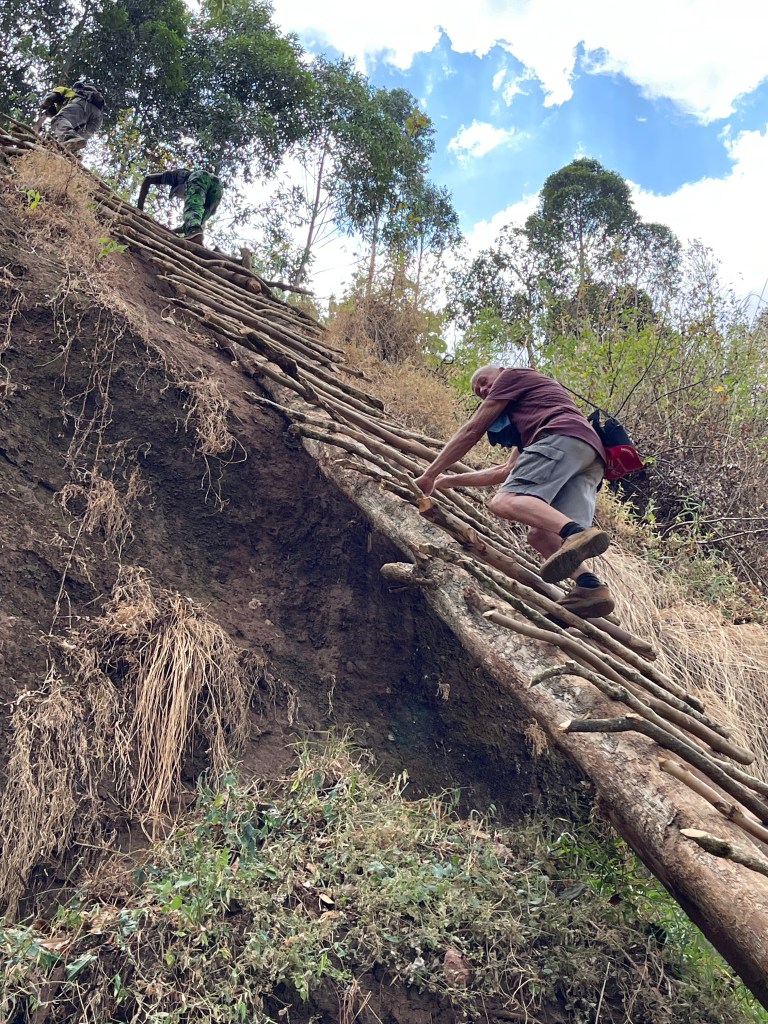
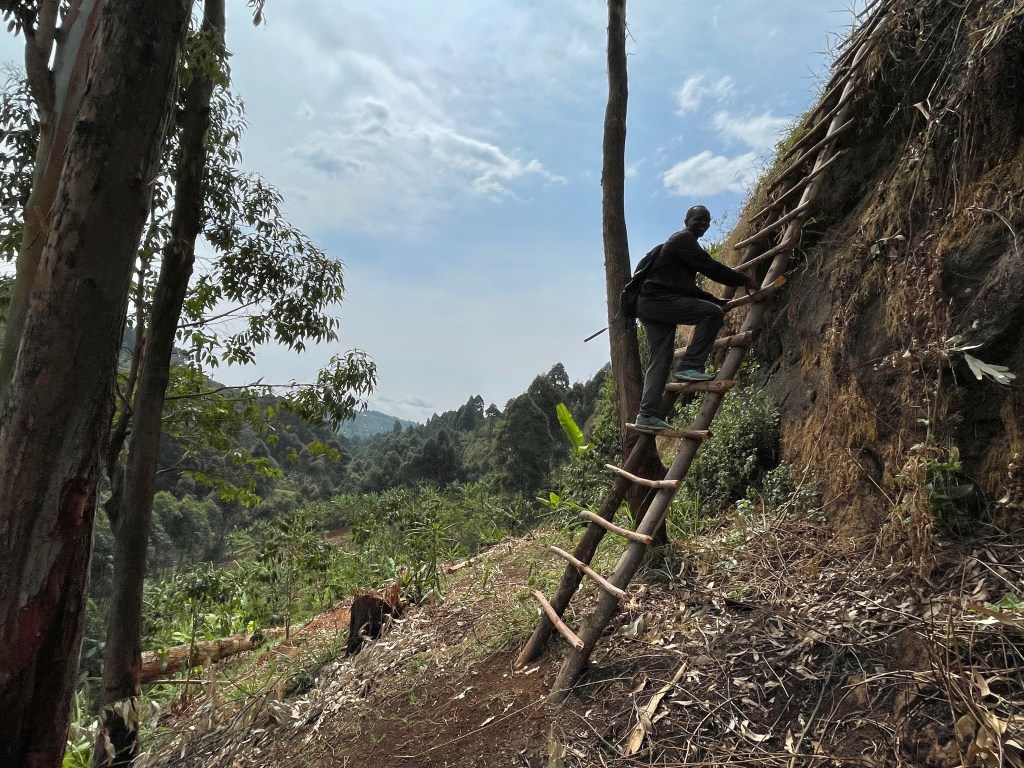
Mad ladders
The maddest ladder
It’d be miles to go round and avoid it!

Why does anyone want to toil round The Sipi Falls Tour, The Sipi Coffee Tour, The Sipi Sunset Walk, when there’s REAL African life just a few miles in the other direction?

More ladders!

Two days ago, I rode a borrowed motorbike, with Alex as pillion, to his sister, Doreen’s home. She’s one of his closest siblings, married to Leonard, a very charming coffee farmer, about ten miles from Sipi. In past years, we’ve walked BOTH ways to visit Doreen and Leonard! This time, we wanted to walk even further from Sipi, beyond Doreen’s homestead, with cheerful Leonard for guide. Remarkably, just ten miles from Sipi, it’s a different language, and Leonard has been much amused in the past to walk with the mzungu.

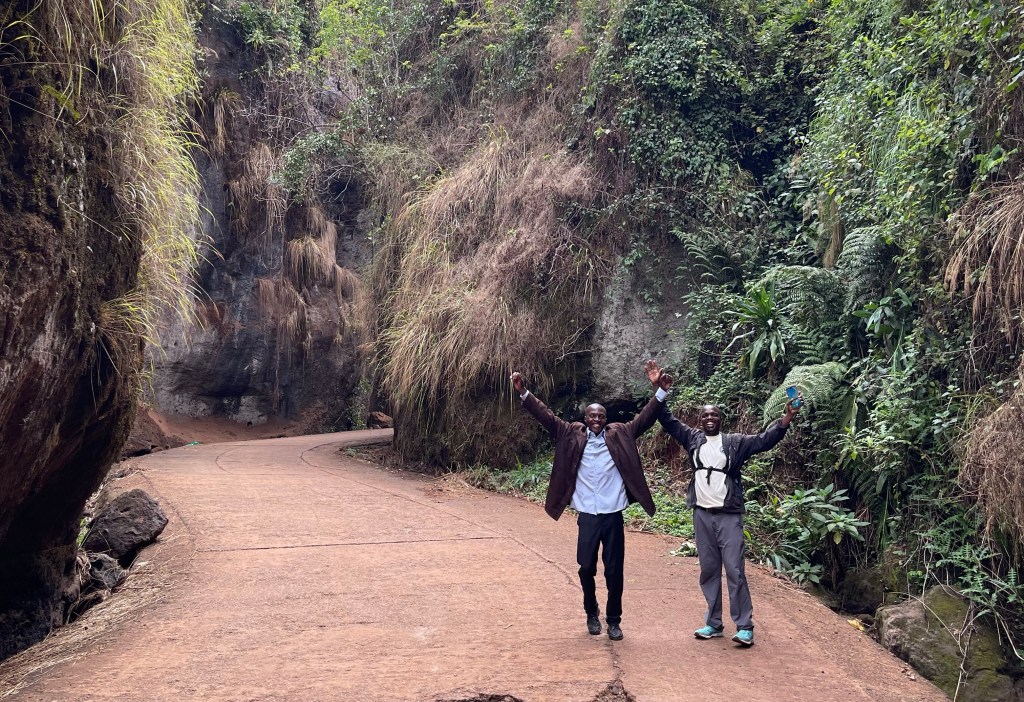
Leonard and Alex. I was told this road was built by a ‘colonial man’ called Mowlem – almost certainly the British road building company

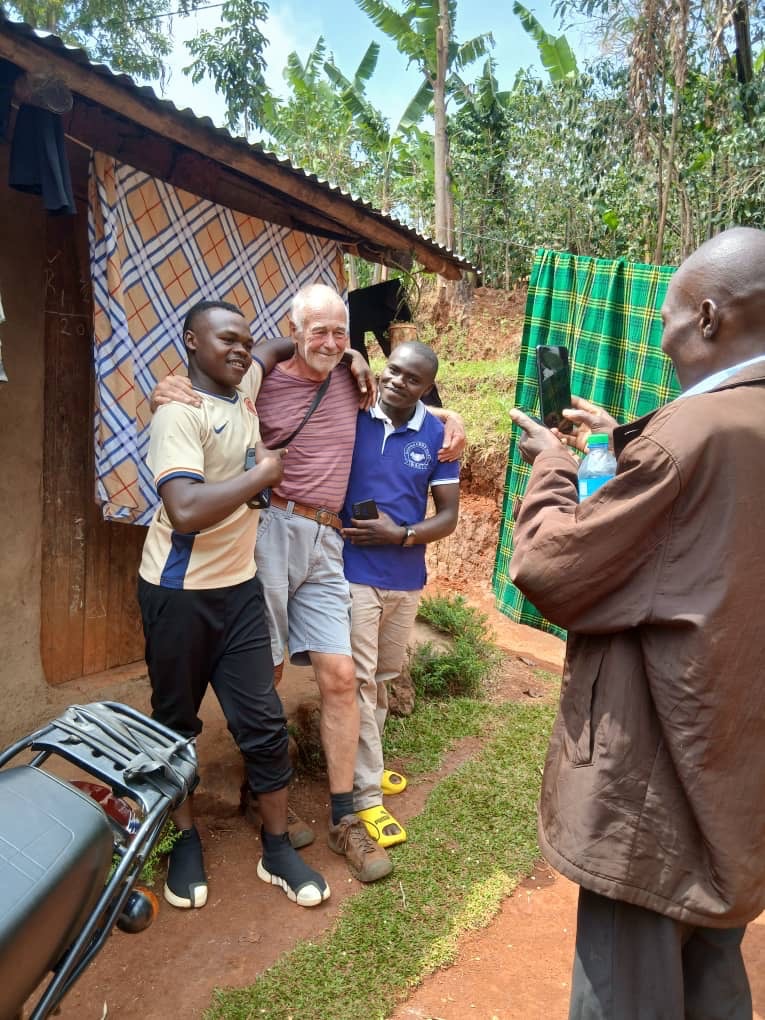
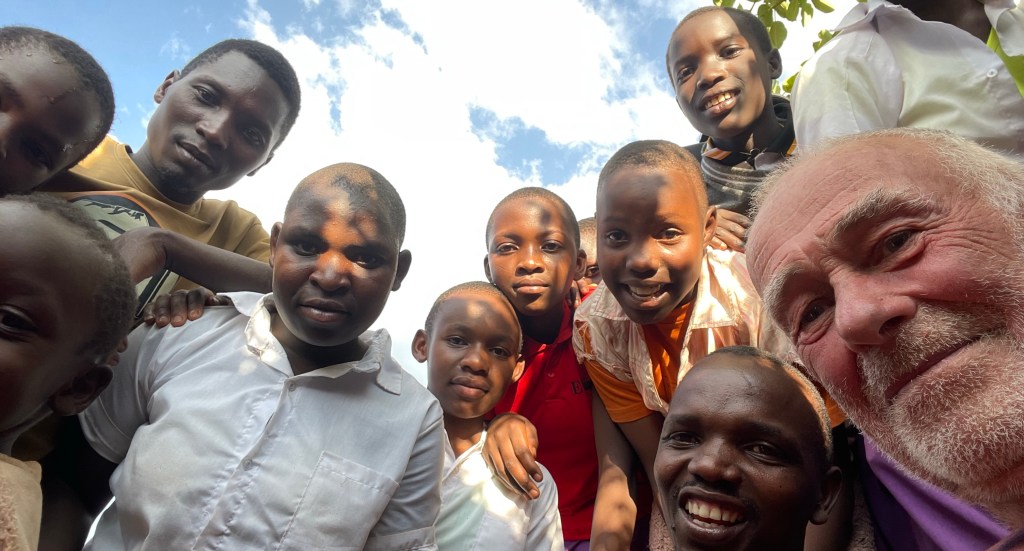
Never before, though, have we caused the sensation of this hike. In so many hamlets, and even one town, people come out to stare. I am, they say, the first white man ever to visit them! It’s SUCH fun to move amongst this goodwill. Children flock or flee; all are concerned that the mzee (old man Huh!) will not survive the clamber up their mountains; Samuel and Robert, late-teen brothers, are so astonished to see the first mzungu to pass their remote rural home, that I have to stop for a selfie; boda-boda riders wobble as they negotiate rough red tracks, staring back at the pink-skinned, rather sweaty phenomenon; madmen gather to talk nonsense; farmers direct our route.

We are high – up around 2000 metres (6500 feet) – in thick green growth, scrambling into steep valleys – one of them 500 feet deep – and up the opposite face, including shinning up a 30 foot rickety wooden ladder. We puff up slopes towards the clouds, always a hill in front. A chapati and disgusting soda bring some energy back on our now hot walk – perhaps about 34 degrees. Dust from hoed cabbage fields fills our dusty shoes; the equatorial sun, just one degree and nineteen minutes south of us, blazes down – and the hills are mysteriously always UP.

I shake at least 250 small black hands; wave at a thousand more lively children in this land with half the population under 14 years, so about 25 million children. They’re so HAPPY to see me. I love it. I’m constantly charmed by all these excited small people. Teenagers giggle, old men salute in a gesture of equality. Leonard introduces his sisters – but then I remember that Leonard is one of 64 siblings. Yes, sixty four… Ten ‘wives’ for his father. “My father was circumcised from this village,” he tells me as we walk. ‘Pity they didn’t cut it right off’, I think. We meet elderly women, probably Leonard’s relations, who must be so legion that my mind boggles, coming from interminable church services of the business pastors. They greet and welcome me.

Eighteen – EIGHTEEN – children at one – ONE – home scramble down an embankment to shake my hand, dragging reluctant tiny siblings to greet their first mzungu. “They’ll be proud at school tomorrow!” laughs Leonard. “They’ll be boasting that they touched a mzungu!”

We turn downhill – it seems unusual on this hike – between matoke trees and extensive coffee bushes: this is coffee country. There are small earth, stick and corrugated tin homes everywhere, hidden amongst the shambas. Children everywhere. Goats, chickens, cows. Eucalyptus trees touching the sky. We’ve walked this way before – two years ago. I am recognised. “Eh, your mzungu is old! Get him a boda!” Huh.

Then, a light amongst the thick growth. By now we’ve walked not less than twenty miles. I feel almost superhumanly fit and healthy. It’s kind of worrying! Maybe I’m like the opera consumptive, fooled by the ecstasy of health based on an underlying frailty of old age? It doesn’t FEEL fake though! I really AM able to clamber up these 2000 metre high mountain slopes and keep going at a good lick with a couple of men less than half my age. I’m taking no medication, often out-walking young men a third of my age (Joshua admits he had to lie down and rest after our walk the other day, and Eric says he’ll never walk with Alex and I again!). I reckon sunshine, altitude, exercise and unprocessed food are a pretty good medicine, without the pharmaceutical con job.

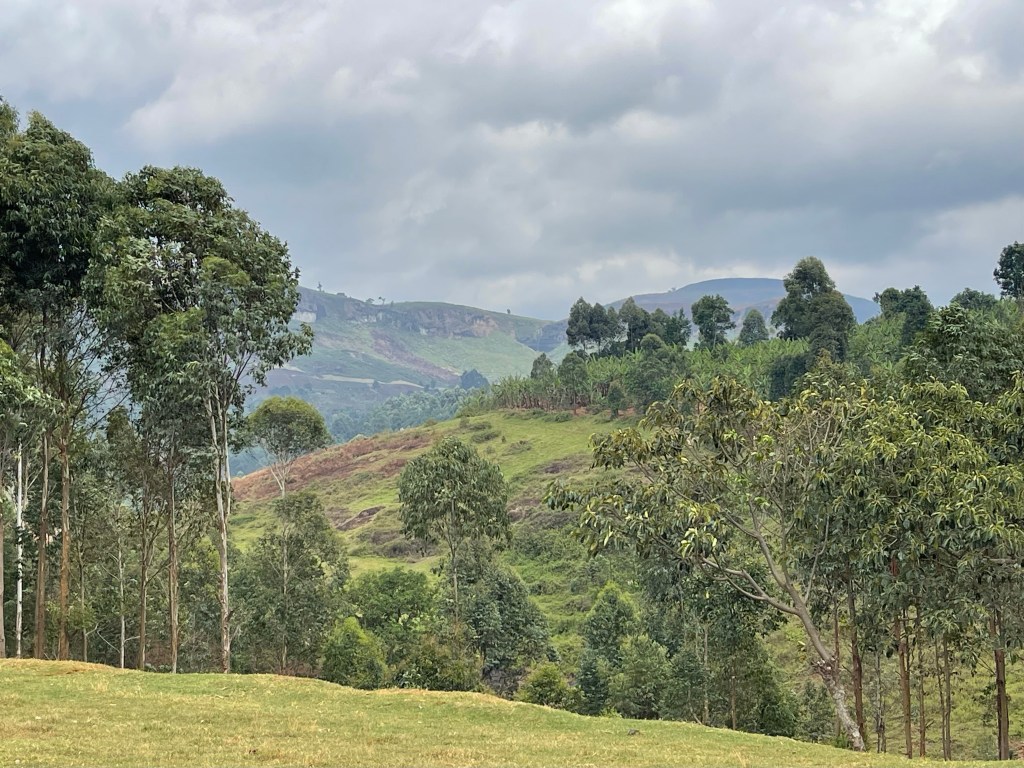
The light between the trees becomes the lip of the astonishing cliffs that surround these great shoulders of Mount Elgon. Then there’s that endless vast void, the limitless view across central Uganda. It’s hundreds of feet below and stretches as far as the eye can see – and the haze can reveal. The sun’s lowering, shadows revealing details that the overhead equatorial brilliance flattened all the hot day.

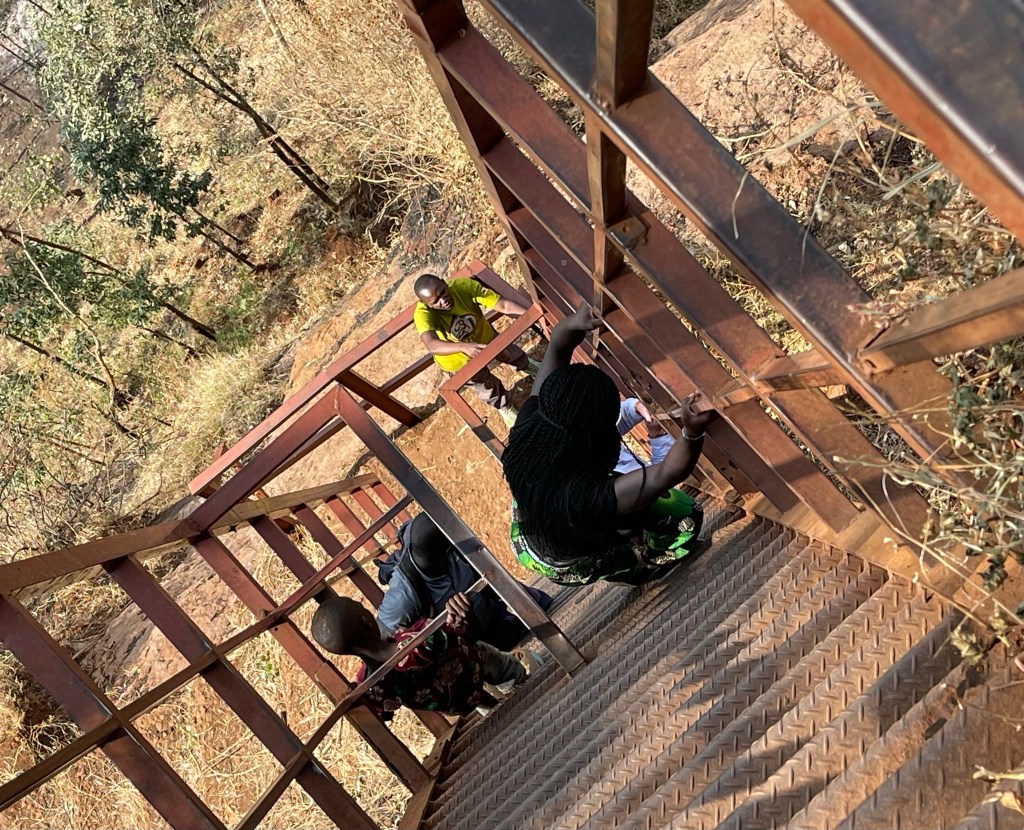
The lip is dramatic: one false step on this dry grass and you’d be jettisoned into the two hundred feet of empty void, then the thousand feet of unstable, matoke and scrub-filled steepness – down to where, they tell us fifteen minutes later, Doreen and her rather many children have been watching us descending the giant steel ladder.

Just the upper ladder!

The lower one is much longer

We’re old hands at this ladder, Alex and I, and Leonard lives at the bottom of it. We sprint down its 143 steep, steel steps, and slither down the dry mountainside to the red dirt road winding in the vast landscape below. I feel SO healthy! I’m hiking with two men half my age, and leading down these slopes. I DO go a bit more warily than I used to, but I’m having such a great day, with good companions. Waiting at the bottom, hundreds of feet below, Doreen has produced – this being Africa, where hospitality is paramount – (even given the reservations of former paragraphs) – a meal of rice and goat meat and homegrown coffee. I can only make a gesture. I still have to ride us on the hilly dirt roads home.

We’re caught by rain on the way home. This is not a time for motorbiking in the East African highlands.

As I write, Alex WhatsApps me to say: ‘Good morning, JB. All is well, but still so fatigued and looking sick! Haha. That was challenging walk. Thank you for spending most of your time with us during this visit. Thank you for the children! Thank you for the money. Thank you for being part of our day to day living. Take good care of yourself. I was just thinking about you being a good father!! I miss you already…’

I respond: ‘Now buck up about being fatigued! No point giving in, my mother always said. Half my age, and I’d do it again today!!’

I would too.

****

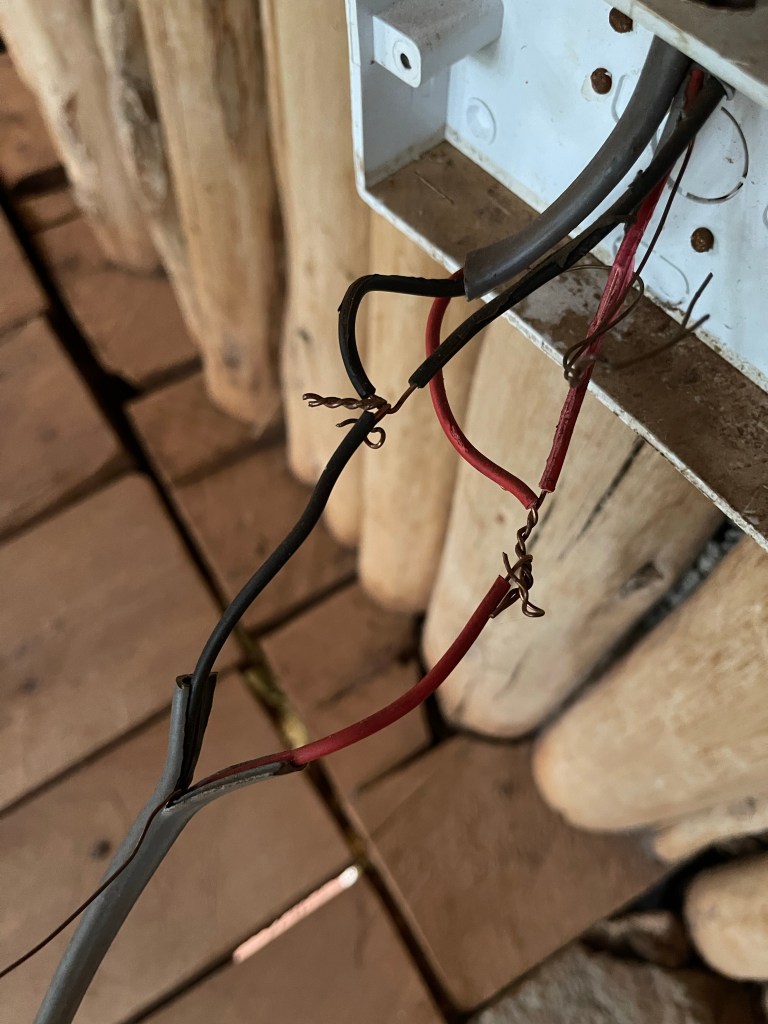
The main 240 volt supply from the generator to the house has been like this since at least October. Shiny wires just about child level… (Now taped by JB!)

No one has any concept of the dangers of 240 volt electricity, unguarded motors, chain saws, gas bottles, petrol – or any of the things we stress about with our attention to H&S. The other day, I found the new 45 kilo gas bottle, for use with the new cheap gas cooker from China (itself a danger to life), in the kitchen beside the open wood range. Shocked, I had a rant and told Alex to buy 7.5 metres of gas pipe so I could connect the bottle to a point well beyond open fires.

Of course, I should’ve known… At the shop in Kapchorwa, no one had a tape measure.

Instead, they spanned the length, stretching their arms wide and saying to Alex, “That’s two metres – four metres – six, and nose to fingers one metre, plus a half! Two metres per span…”

Alex is not at all practical. The average Ugandan is about 175cm tall. If that.

The ‘seven and a half metre’ pipe that Alex brought home was 5.7m long! God, working here is frustrating. I had to get Moses to build a brick platform to raise the gas bottle to reach the end of the bloody pipe! Just as well a scenery designer is adept at making compromises with what he has.

****

On the 2nd, we went to visit the children at their smart new school. We miss them so much about the compound at home, but local schools are pitiful and this boarding school, 30 miles away is the best in the region.

Last January, my old neighbour Betty, died in Devon. The ‘mascot’ of Harberton and friend to all; a woman always positive about life, even as her disabilities increased in her 97th year, she was a popular villager and became a fond friend. She took delight in stories of Keilah and Jonathan, sending them Christmas cakes and listening to their shrill songs of thanks on my phone. She couldn’t see well enough to watch their antics, but loved the glee in their high-pitched childish voices.

On my return from Africa last year, after Betty died, her son presented me with a plastic cake box wrapped in a doily, on which was written in a shaky hand, ‘For Jonathan with love from Betty’.

‘Crikey,’ I thought, ‘this’ll be stale!’

Inside, the box contained, not stale cake, but one hundred ten pound notes, carefully secured by a rubber band. Saved from her pension. I was very touched and understood her tacit hope was that her gift would help my ‘grandchildren’ in Uganda.

I used Betty’s money to pay the registration, uniforms and first term’s fees for the two children she’d loved to hear singing, at one of the best schools in eastern Uganda. Of course, I get to pay the rest..!

They love their school; are thrilled that it has a small swimming pool (“I don’t even know where to buy Keilah the swimming costume she wants!” laughs Alex), and have already made many friends. Seeing Uncle Jonathan arrive, Keilah came racing like a cannonball across the school yard.

We got them exeats from the administrator and took them out for ice creams and chips, for our enjoyment at least as much as theirs. I DO miss those two, and won’t see them for eight or nine months.

JB shows his exeat

Some days later, Alex had cause to ring the matron at school. She asked Keilah if she wanted to talk to her father. “No, Daddy will be busy with his guests. I don’t want to disturb him. I’m reading my book.” A confident little girl.

****

We suffered two more disco funerals this past couple of weeks, and sealed the land deal for the coffee plantation at Chelel. Representatives from the clan, the district council and the sellers gathered to formally exchange the final payment under the avocado tree at Rock Gardens. One elderly man, an ex school teacher, drew up a document in the dusty exercise book in which Alex records his land purchases (six plots now). Everyone witnessed the somewhat scrappy document, including a number of biro-inked fingerprints in this poorly educated neighbourhood. Debra, the lawyer, got photocopies and insists on Alex getting the titles to his plots – another large expense, but a wise one. Copies of the papers will be lodged in a lawyer’s office in far away Melbourne!

The deal confirmed. Alex, Precious and Debra at the back

****

You’ll want to hear the outcome of my Mosquito trials and tribulations… While I as in Uganda, the Sikh Suzuki dealer in Nairobi did me a very fair and kindly deal: they serviced the bike to running condition, but without the new CDI control unit that it really needs to be trouble-free. Then it was sent back to Kitale. It’s now in Rico’s big garage.

I’ve decided to sell it. After all, I have had seven fun years, but my use of it dwindled as I began to distrust it. And my expenses rose: almost £900 this winter alone. We’ll either sell it through contacts of Adelight’s here in Kenya or somewhat illegally but at a better price, in Uganda, across the leaky border. It will be a popular bike; many riders admire my ‘big’ bike (smallest of the 17 or so bike’s I’ve owned).

Once sold, I will decide on a replacement. I favour a Yamaha 200AG, made as a farm bike and popular in out of the way places like the Australian bush. They appear to retail at about £2600, so if I can raise over half from the Mosquito, I will be happy. All to be decided…

****

Adelight is busy with her construction project. She smartly registered to be a contractor for government building projects. Her first is to complete a two-classroom school building. She’s in the final stages, with not much over a week to go. She’s formed a team of eight men and has already been approved for another contract at the same school. The walls and gate for the four acre plot should be lucrative. Bizarrely though, she has to invest her own money in the materials before she can get payment. This is Africa. It’s the way business is done. For this initial contract, that presents a problem, so I’ve stepped in to lend her a hefty chunk of cash, in the expectation that her – quite big – profit, will provide the capital for the next work. I’ve told her, it’s repayment in May – or my teeth! I’m looking forward to getting shot of the temporary denture forced upon me shortly before travel this winter! No repayment: no new teeth…

Still, if that’s the worst that old age is thrusting upon me, I can’t complain.

Tomorrow, I’m off back to Kessup. I hope the rain holds off for another big hike into the deep Rift Valley. Rain, says the forecast: 2mm tomorrow, 10mm on Thursday, and 0mm for Friday and Saturday. I should get some hiking. Have to keep moving, even as I leave a trail of young men who swear they’ll never walk with me again! Haha!

****

At least I don’t have to work like African women…

Women’s work…

EPISODE FIVE 2025

FEBRUARY 27th 2025
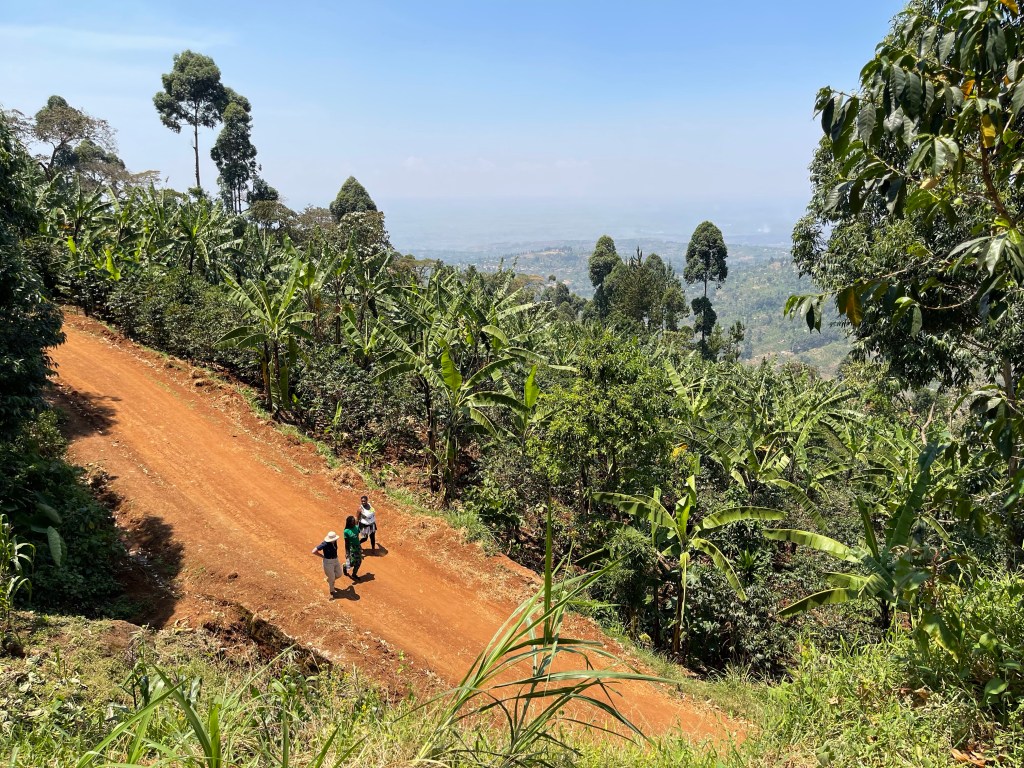
Alex in a Sipi sunset

A MZUNGU COFFEE FARMER, AND THE MOSQUITO, SWATTED AT LAST..?

It’s been a costly but rather exciting time, these past two weeks. I’ve become a land owner in Uganda again (by proxy of course, since it’s really Alex that benefits), half killed my ageing body in equatorial heat on a near-vertical slope at 7000 feet, stayed five days doing NO work at Rock Gardens in Sipi (unheard of), spent a shedload of money, and probably said goodbye to my trusty, flighty friend, the Mosquito.

It all means thinking anew about my African safaris…

****

Slightly overlapping with the last episode, I’ll start with the exhilaration I felt at purchasing what must be about two and a half acres of Uganda for Alex. (Well, actually, to be honest, probably for Keilah!). We hike one day, dropping down into the hot plains below Sipi, a dramatic walk, slithering down the steep escarpment, the heat increasing with every metre. The red cliffs soar over us, trees fringing the top edge with a feathery silhouette against a huge blue sky. It’s beautiful on these slopes, many shades of green, colourful bushes decked with blue and yellow flowers.

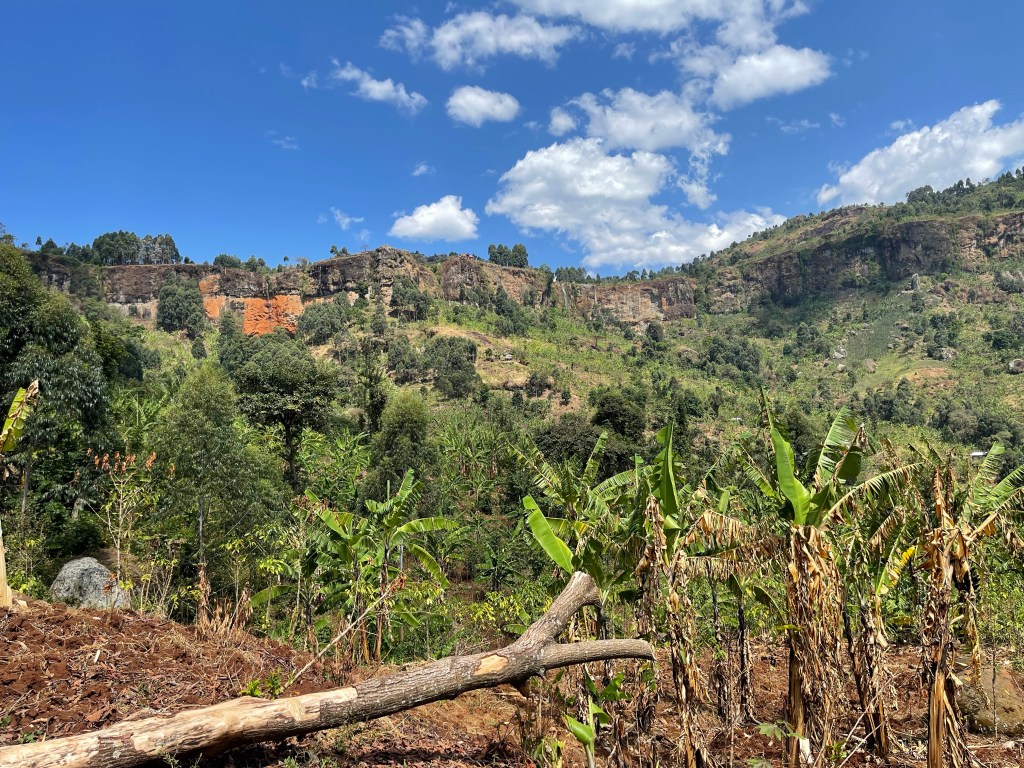
Great hiking country. Some paths end in ladders at the steepest points on the cliff

As we walk, Alex’s phone beeps constantly, an irritating jingle that indicates messages. Many of the interruptions are bookings for Rock Gardens, such a success story. Today, though, it’s busy with a series of voice calls that take his attention. Something’s afoot.

****

A young man overloads a decrepit boda – almost nothing of the motorbike seems to work, except the engine – just. The clutch pivots on a bent three inch nail. The rider is securing – riskily – a VAST load of weighty matoke banana bunches on the 100cc machine – of which probably few more than 50ccs are operable. The curving green fruit-laden branches scrape on the dust but he ties another hundredweight bunch on top. He’s going to ride these grossly overburdened bits of motorbike about fifteen miles, sitting on the tank, to a village I know, where Alex and I have walked. I wonder that these red tracks even join up, let alone that what’s left of this wheezy machine can wend around these bumpy mountain lanes. How the heck does it get up the hills? Alex give him a bump start. It’s not difficult to turn over the few ccs of engine that are left. The rider wobbles away. I think of the banana that breaks the camel’s back…

Punishing the remaining bits of an African motorbike

Alex’s phone rings again. You’re never alone with a mobile phone, certainly not in Africa, where phone ownership is higher than the EU. Alex’s conversations are in Kalenjin, so I understand nothing, but there’s an urgency to the repetition, and Alex’s mind is elsewhere, only reluctantly pulled back to my questions and observations like a good host and son. I know Alex so well that I recognise his preoccupation and earnest talk. After all, I see so much of myself in him. It’s a deep bond. He really does feel like a son by now, just as Wechiga in Ghana feels like a true brother. But Alex isn’t sharing the calls with me. In time, I know, he’ll tell me what’s up…

****

We get home in the late afternoon. The guest house is full again. It’s such a success! I smile to think that I’ve been partly responsible for lifting this charming family into another sphere of confidence that’s securing their future. Yes, it’s taken the sort of money that many, back home in profligate England, spend on a totally unnecessary, planet-threatening modest 4X4; but isn’t THIS a better use? The future of my ‘grandchildren’ is assuredly more positive, and that effect is exponential. It’s like planting and nurturing a small tree: one day maybe there’ll be a forest.

****

Next morning, I’m at my breakfast when Alex comes to greet me. He’s already been out somewhere, since he got up to prepare our buffet meal at 5.30. I woke briefly to the sound of chopping wood for the cooking fire: a sound that daily prompts my earplugs before dawn.

Later in the day, as the heat wanes from the intense sun – it’s forecast to be 35 and 36 degrees in Sipi all week, and the rains look to be coming late this year – Alex encourages Precious and I to a walk. “There’s somewhere I want you to see…” He fools Precious that it’s not far, although it’s probably a couple of miles of hills. The final hill, “Just one last hill..!” is steep. Precious rebels. She’ll wait for us at the bottom. I tell her she might get attacked by bears – of which there are none within several thousand miles! It’s enough to spur her up the last sharp incline, where a small gaggle of local people await us.

Above the road, atop a ten foot embankment, we are shown the plot for which Alex has spent the past 24 hours negotiating! I’d suspected this. I sort of know what’s coming next…

It seems that this family has been given the land by their grandfather, but there are many brothers (no women of course) who want to share the proceeds of selling it. Most of them are scattered about the area, but not here in Chelel. With his new status, Alex has been identified as a potential buyer. It’s a large plot; I can’t believe quite how big it is, it looks well over two acres. I’m keeping a low profile as I don’t want them to think a mzungu is behind this deal: the price might go up. The land slopes steeply upward to a 50 foot bluff dominated by some slender eucalyptus trees. It’s been hoed. There are some waving matoke trees, quite a few old coffee bushes – and a wonderful view back towards Sipi.

My first view of the Chelel Coffee Garden

“This will be at least twenty million!” whispers Precious. “TWENTY MILLION!” I wander away with one of the nephews. The soil looks very fertile, even to me. Best of all, there’s a stream burbling down one side. But 20,000,000 Uganda shillings..? I clamber to the top, pretending to be disinterested in the discussions below. The view expands, but we’re not here about views, this looks to my untrained eye like valuable land.

I slither back down the turned clods of earth to Alex, Precious and the assembled sellers. Alex confides that he’s bargained down to fourteen million shillings. But I know it means a quick agreement. It’s £3200 and I can’t get that much immediately! I do agree, though, that it’s a great purchase! We all shake hands and Alex, Precious and I walk home in the setting sun. It’s so beautiful along this escarpment at this hour. We are a bit excited, even me, who’s about to shell out a large chunk of my annual state pension!! “This is the BEST coffee growing area around Sipi! Chelel it’s called,” says Alex.

A fabulous view back towards Sipi

“If this goes ahead, Alex, I expect a lifetime supply of my own branded coffee! And I mean that. You have to find a way to send it to me!” He laughs happily.

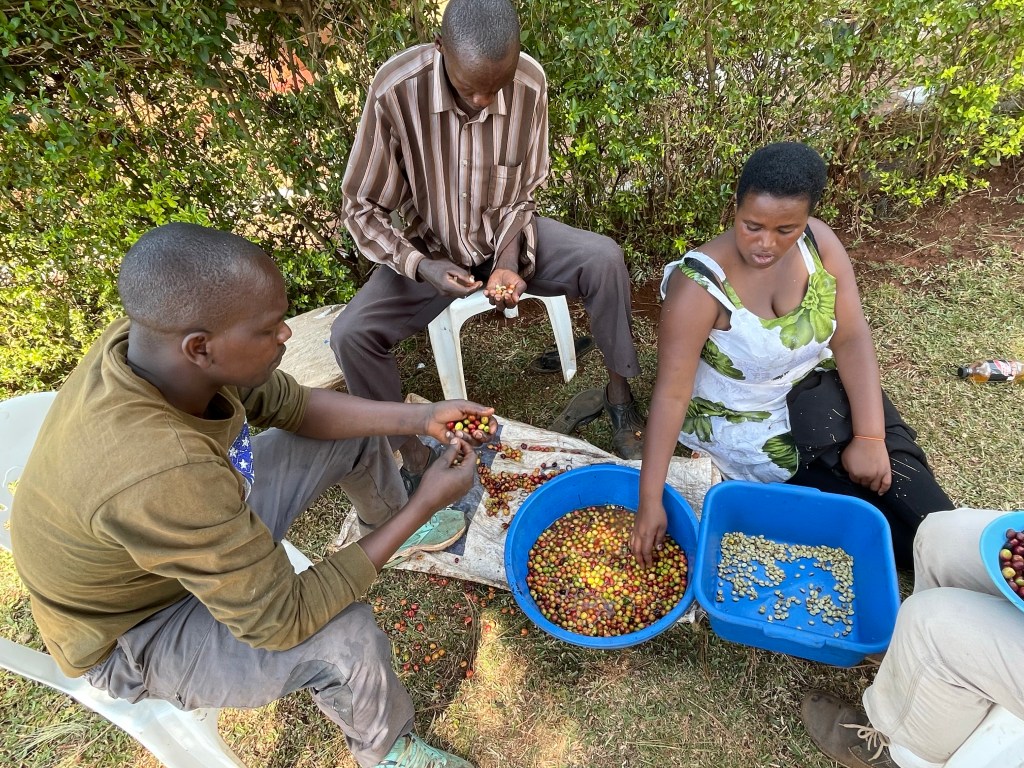
Alex, Tom and Precious shell coffee beans collected from our new garden – a tedious process, but ‘first fruits’ for me to bring home

****

Tonight, another bloody disco funeral thumps expensively and disrespectfully away at the top of the road, about 400 yards from Rock Gardens. I hope I can cut most of it out with the earplugs. What a ghastly parody of culture all this is. Bass notes pumping. Thankfully, I’ve agreed to return to Kitale tomorrow.

The man who’s died, in his 60s, was the one who spread the mean opinion that Alex was stupid to cut down the matoke and try to build a resort here. It’d never work, he told the neighbourhood. Alex was a fool. “Well, at least he lived long enough to see Rock Garden’s success!” says landowner Alex with a chuckle and a confidence that is heartening.

He won’t be paying his respects at THAT funeral!

****

The sad demise of the neighbours’ Lollipop Tree, by which I could always identify Rock Gardens from afar

Next day, I ride back to Kitale. The thumping funeral lasts for several days this time, Alex tells me in a WhatsApp message. Some of the children had to gather from far away and the noise pollution continued until the final burial. He also sends me pictures of a gathering of his clan elders under the shady pine tree at Rock Gardens. One photo shows the chairman of the clan handing a five inch wadge of crumpled Ugandan banknotes to the family head of the Chelel field.

Clan elders and interested parties kept occupied in Rock Gardens while Alex works out the deal

Later, he tells me the story of that picture. “Hey, I was busy! BUSY! It was a long day for me! The five million (£1126) you transferred to me that morning was enough to keep them interested, but there was another man, one of the RICH men of Sipi, who wanted the land! He was offering a million more. So what I did was, I sent motorbikes to collect all the selling family members and all my clan elders to Rock Gardens. I told Precious to make plenty of tea and chapatis!” Alex laughs as he tells me. “Then I raced to the bank in Kapchorwa… I asked the bank manager for a loan of six point five million (£1500) and said I’d pay it back in two weeks. He wasn’t sure. But I convinced him I already had the five million. I sent transport to bring the old grandfather who was giving the land to his family. I phoned Precious to supply beer and more chapatis! Eh, it was close! I got in by inches ahead of the rich man!” Canny Alex, he deserves his growing reputation. I’m so proud of him.

The clan chairman and family head and a thick bunch of money

We are now coffee farmers. In one of Uganda’s best Arabica coffee growing areas. And coffee is one of the country’s richest exports. People in the know tell Alex that properly managed, his land could return the investment in two to three years. What’s more, he repaid the bank in nine days, gaining the manager’s confidence and paying just £12 in interest.

****

Meanwhile, I ride away to the Rift Valley for some days. Then I’m back to Sipi to see Debra from Melbourne, and her protege, Rebecca, an AIDS orphan from Jinja, a sweetly innocent young woman with a warm heart. They visited last year and quickly and instinctively became part of our family.

Debra and Precious share a joke

Debra, at 67, is an older traveller who’s seen a lot of the world and 30 years of Africa, in the old pre-tourist-trail days. We share many similar views on travelling and the world – both widely influenced by our travels. She seems comfortable in her skin and is probably enjoying her 60s the way I did: nothing much left to prove, knowing herself well, a good social presence and a great sense of humour and way of looking at life. Alex has invited Rebecca to join his small staff at Rock Gardens to cement the friendship. He’ll be a good mentor and protector for the young woman. She will develop confidence there.

****

Happy walking to Chelel. Debra, Rebecca and Precious

A few days after Alex has signed and sealed the deal, we all set out to walk back to Chelel, a happy, rather excited bunch, going to look again at what’s now OUR land. Alex, Precious, Debra, Rebecca and I are joined by Tom, the wood butcher and friend of Alex, and Moses, the best worker he’s ever had at Rock Gardens – who already has plans for terracing and water channels as he and I clamber about the slopes of the plot. We are all exhilarated to be here. Precious has brought a pineapple for the first picnic. Tom climbs up the mountain to a small village with a kiosk, for sodas and biscuits. He comes back and relates that the gossip around is that a mzungu has bought the big plot.

I’m a bit embarrassed. I don’t like this perception of my privileges. But Alex is delighted! “That’s GOOD!” he exclaims to my surprise. “You see, JB, if they think a mzungu owns our land, it will be MUCH more secure. Mzungus don’t mess with wrongdoing: they chase and prosecute! We Africans just shrug and say, ‘that’s Africa’.”

A happy picnic. Neighbouring plot owner Steven, Alex, Debra, Precious, Moses, Tom and Rebecca and the first gathering at Chelel Coffee Gardens

As we drink our pop in the shadow of a big rock (“Very good rock for building!” exclaims Moses happily) we are all a bit high on the ownership of Chelel Coffee Garden, as I’ve begun to call it. We’re already planning a small terrace from which Alex’s customers can enjoy the spectacular view, fresh coffee and our own coffee tour hike from Sipi.

“But remember, Alex, I expect a lifetime supply of ‘Chelel Jonathan Bean Speciality Coffee’!”

“Oh, I’ll find a way, JB!”

****

In the midst of all this excitement, I rode back through Kitale to Kessup and some hiking I’d planned with William. In Kitale, Adelight has employed a ‘house girl’. She’s there to look after Maria when she comes from school while Adelight is busy at her new work site, overseeing the construction of a government primary school, now that she’s licensed for that work. My families are entrepreneurial and prospering. It’s so satisfying that their initiative, given a leg up by my support, leads to success. House girl, Brenda, is quiet as the proverbial church mouse, and terrified of mzungus. I don’t know her story, but I know she was abused in her previous job. She finds a mzungu who helps to clear the table, does his own washing and is polite, something of a mystery. She lives in a corner of the living room, no privacy, no independence. What an odd life, typical of so very many here: grateful to have some form of work, however menial. She’s a hard worker but a completely blank page of personality for me. Ah, Africa: STILL a mystery…

****

In Kessup, William is so proud of his cow, Dutch, a Fresian, and her male calf, British. Dutch is pregnant again, with a guaranteed female Holstein. Even I’m learning about cattle these days! Apparently, with semen imported from Netherlands, William gets a female milk cow or compensation. Holsteins, he says, can give up to 20 litres of milk every day. “Eh, JB, you’ve made me a dairy farmer!” says William proudly, stroking his pampered cows.

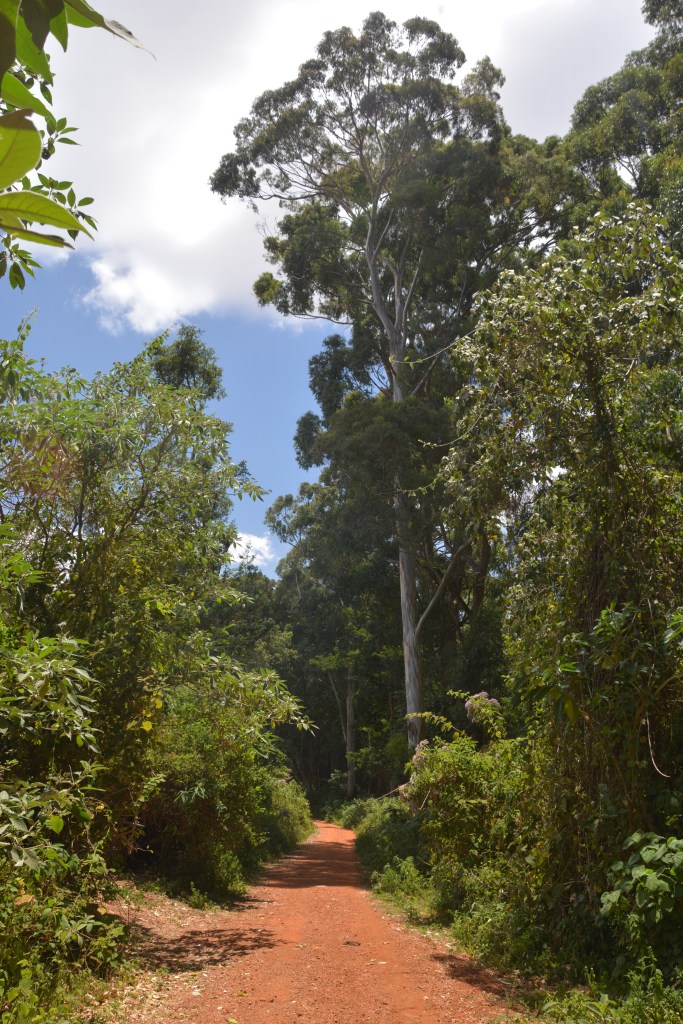
Next day, we walk up to the main road and take a boda to Iten, the town on the lip of the great valley. We’re going to hike in Singore Forest again, a favourite of ours. I’m glad I’m not running though, like the Olympic athletes who train here at 8000 feet… The forest is protected government land, edged by shambas and grazing. It’s handsome scenery, dappled by the high sun, blazing from a deeply blue sky. The undergrowth is thick and the tracks red dust and rock. It’s peaceful and restful, filled with huge mature trees; pity so many are eucalyptus, the thirsty weed of Africa, but they’re still giants: some must be 80 or 100 feet high, soaring overhead. It’s magnificent. In one place very tall conifers dance together in the stiff breeze. As they wave high above, they make a wonderful clattering, groaning noise as if they were talking. Magical.

Singore Forest

It’s tiring up here. We greet and chat as we walk. William’s an easy companion. I shake a hundred hands and return a multitude of smiles. Away to the east, the great valley plunges below; the giant void that splits the length of Africa.

****

The following day, despite weariness, we launch ourselves into the enormous valley. Crazy? It’s very hot at present, up in the mid- to high-30s.

It’s a hard walk, down a new track. I don’t like the loose rocks. I’m more anxious and wary now. I know that a slip can be disastrous. I don’t think I like old age much!

Hot and dry, but a sense of achievement

Still, we make it down yet again. An uncomfortable hike, dropping 2700 feet. This is a remarkable part of the world. I do love this region. The expansive views are astonishing, stretching into the heat-hazed distances and depths; overhead, the blue sky seems almost a physical surface, rather than an intangibility of air and light.

At last, we are at the bottom. We meet people again, a group of older men, watched by youths and children, sitting on a big low rock amongst homesteads. Friendly folk, a woman brings us a giant, ripe pawpaw. It’s a welcome to strangers. A fine gesture. As usual, it’s the people with little to give that prove to be the most generous.

We need the fruit and sugar; I’m exhausted, more than previous years. I suppose it’s inevitable… And it’s as hot as Hades down here. On the boring white road in the valley bottom, we take a boda to a tea house, and then the very basic hotel at Kipkoywo, to a bucket shower in water warm enough to make tea, and meagre food.

William relaxes at the ‘hotel’ as the sun wanes, having fetched our beer from five miles down the dirt road. Elegant it’s not…

My room’s a hothouse; no more than a bed with a sheet, a basin and a burning tin roof. It hardly warrants the name ‘hotel’. Sweat pours as I go to bed at the bottom of the Kerio Valley.

****

…But we have to go back UP..!

A sweaty night and a second HARD day. Never too old, but sometimes I wonder… Maybe this should be my last climb out of the Rift Valley? I’m almost beaten where the unfinished rock road turns into a rocky clamber for 850 feet, straight up the crumbly mountainside. Last year, I laboured, this year I’m REALLY struggling!

Hot as hell and twice as steep…

But the day IS extremely hot, floodlit by the immensity of the equatorial sun, half a degree north of the Equator. We climb 2663 feet in eight and a half miles, having somehow survived on half a litre of warm water, a mango and some peanuts. At the top, I shock William. “You’ll not believe this, but I’m craving a bottle of pop!” Last time I drank high fructose corn syrup poison is years ago! Thankfully, a kiosk provides a small bottle of ‘energy drink’, a disgusting concoction of chemical sugars. It works.

And I DO prove I can still hike into and out of the 4000 foot Rift Valley, even if it’s becoming more challenging.

****

So what of my poor Mosquito..? Ten days or so ago, I was riding to Uganda, the engine misfiring and hesitating. Twenty kilometres from Kitale, I did a U turn, deciding to send my ailing motorbike by road to the Suzuki dealer in Nairobi. Perhaps I should’ve done this months ago? Before I spent all the money that Kato the mechanic wasted on bodged repairs.

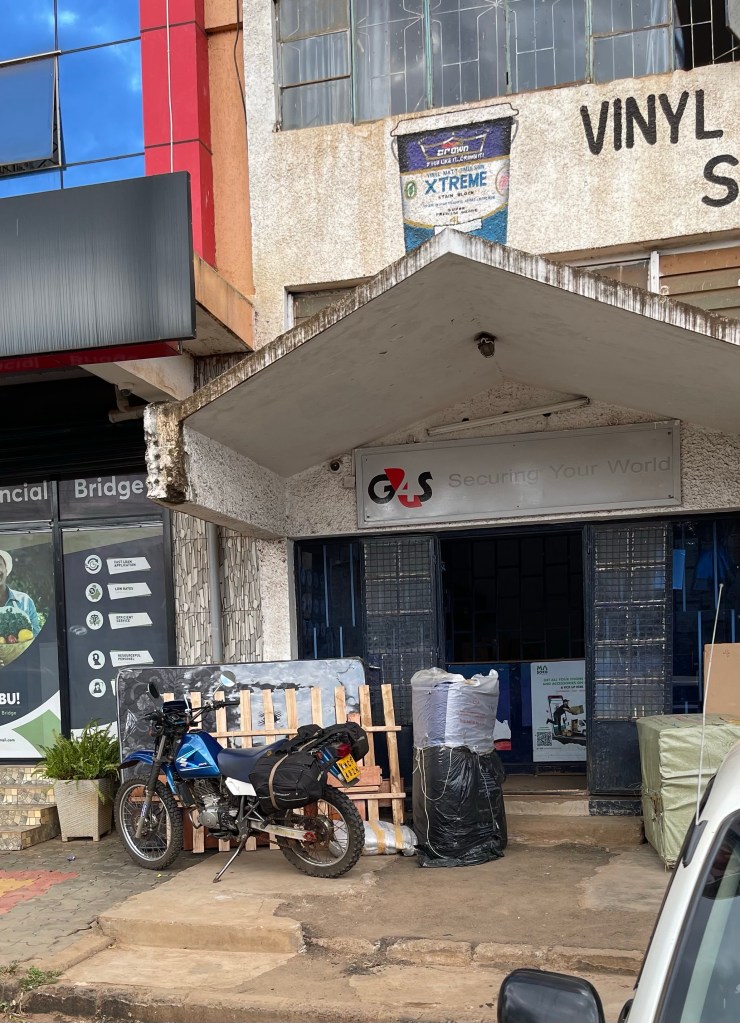
The Mosquito awaits transport to Nairobi outside G4S in Kitale

A week later, after a trip to Sipi and back by other means, I flew down to Nairobi, hoping I’d collect the bike and ride it home. Some hope. I came back the 250 miles by bus yesterday!

The owner of the dealership is a Sikh, proud, honest people. He broke the news, telling me in no uncertain words the state of my poor butchered Mosquito.

He’s amazed that it’s still running; that the clutch hasn’t seized, since much of the clutch-plate material was littered in the housing and infiltrating the engine; the crankshaft is loose, missing a C clip that should locate it, causing a leaky seal; the electrics are a knitted, knotted mess; the control unit (that Kato replaced at huge cost – best part of £300? “It’s original!”) is for a boda-boda and unsuitable to run the 200cc engine; the regulator for which I paid £90 is worth about £20; the rings need replacing as the barrel is a mess; the inlet valve has a ridge in it from the use of an incorrect size of front sprocket sometime in the past, and a list of disasters.

To put right just the engine parts, not including the electronic bits, would cost £980! The control unit would be hundreds of pounds more! So, after an hour’s discussion and helpful compromises from these decent people, they will rebuild the machine with some substitute parts, get it running (without a new control unit) and ship it back to Kitale, all for about £150.

Now I must make decisions: sell it as seen, for which I might get between £400 and 600; risk riding it more – but with a dicky control unit, or..? Well those are the choices. I’ll have to rethink my winter journeys.

I could buy a boda-style machine perhaps, but they’re small and uncomfortable and unsuitable for the trails I still enjoy. I could travel by public means – a terrible hassle as a mzungu. Not coming isn’t an option, when the families mean so much, especially Keilah, Jonathan and Alex, and I can’t stand the thought of winter in Devon until there’s no choice!

I could afford a new ‘proper’ bike, but it’s a lot to spend on a few journeys for however long I’ll be able to do it… I’d rather have a trail bike, but don’t want to keep eating my savings. If only we knew how long we had to live, life’d be simpler economically!! Oh dear, I hate these decisions!

Said my German friend, Jörg, when he and Wanda stopped in Sipi overnight last week on their way back to Tanzania, “Wanda and I think you are sponsoring all these people; you should sponsor yourself! To a new motorbike…”

To be continued.

Debra, Rebecca, Wanda, Alex and I enjoy a final get together before Wanda and Jörg leave for home

****

To finish on a cheerier note…

I went back to the Uganda border by matatu while my motorbike was in Nairobi. The slow matatu minibus took an hour and a half to travel 44 kilometres – 18mph, slowing to a crawl for every speed hump, of which there are 60 between Kitale and Suam. None of the doors opened from the inside, there was a pungent stink of petrol, the seat had lost its springs, elbows poked, we were four people including the taciturn driver across the narrow front seat, passengers shouted into phones. The reality of African travel. Another reason for some hard thought about future transport.

As pillion, I can at least enjoy the view…

Alex arranged for Boy to ride to Suam to pick me up; one of the only riders I can contemplate for this journey. Like most untrained African riders, he can’t quite understand engine braking as a concept, so it’s a bit jerky, but he rides quite well and looks after his TVS 150cc bike, that’s surprisingly able to deal with the hills. The bike is small and my knees seize up by the time we reach Sipi – but I might ask for a test ride next time…

How could I get bored of this ride, despite the number of times I’ve ridden this familiar road?

Sitting on the back of Boy’s bike winding along the wonderful mountain road between the border and Sipi, I’m thinking what a charmed life I lead. Not bad thoughts to be having. The scenery’s spectacular, even if it’s become rather familiar, the times I have ridden the road. The sun’s blazing down and Boy rides reasonably safely, such that I can gaze over the wide views of northern Uganda. I’m fit as a fiddle despite my age, no worries, surrounded by caring friends and self-created families, seem generally liked, financially stable, doing what I want, have a lifestyle full of incident, interest and friendship.

Making bread with Precious and Rebecca. If she joins Rock Gardens, Rebecca may make the bread

It’s been a life of riches: no wars to fight (I remember the day military service was abolished – with relief even as an eleven year old!); we had antibiotics, the NHS, free tertiary education, now pensions, bus passes and senior citizen rewards, and possibly we’ll be one of the longest lived generations too. But most of all, of course, we’ve had the unearned wealth from the housing boom (that at the same time will prevent future generations from ever enjoying our comforts).

I DO get tired more quickly. I DO get more irritable when things go wrong. But I’m also finding that the satisfaction of my relationships and families overwhelms my restless escapism and search for new experiences. My urge to see new places has reduced. A bit. My ability to relax has increased. A bit.

I’m in Africa, making stories. What fun!

****

Alex visited the children on Sunday. He Whatsapped happy pictures. “I didn’t want to leave them!”

When they were left at school a couple of weeks ago, Alex had to rush to the supermarket to buy supplementary treats. The school allows them to augment their basic school diet with biscuits, bread, peanuts and treats.

Six year old Jonathan had finished his considerable supply.

“Where’s it all gone? You can’t have eaten it all already!” asked his astonished father.

“Well, Daddy, I have a lot of friends now. I shared it with them!”

Alex went to the supermarket again…

I’m on my way back this weekend. We’ll take the children out for ice creams!

****

Poor Elio, the friendly cow, named after a first guest, gets treated by the vet. Held by Tom and Joshua, comforted by Precious.

Elio’s daughter, Lalla, named after a young Dutch traveller who helped deliver her, is becoming more friendly now too

Alex at sunset